* Fixes an issue with moving directories across volumes
* Removes usages of WebClient
* Removes usages of Cryptographic Providers

Note: Even though .NET 6 introduces Xoshiro RNG, there is no way to control the seed. I'll do some reconciliation of Xoshiro so it functions closer to the built in one. For the most part, it has parity though.
Benchmarks show there is nothing odd about the implementations, they are within 1ns of each other.
* Adds Dictionary serialization rule for codegen
* Adds Tidy for Dictionary. By default will remove key/value pairs where the key or value is either null or deleted. Only works for ISerializable keys or values (or both).
* Adds save flag support (see `ElvenGlasses` for an example)
* Updates AOSAttributes so they are code genned
* Fixes embedded object support by adding an `IRawSerializable`
* Fixes various inconsistencies in serializing with codegen
* Adds code genning for embedded objects. See `AquariumState` as an example.
* Adds code genning for fields that are `Timer`. See `Aquarium` as an example.
* Codegens aquariums
* Fixes missing option for most primitive field types.
* Fixes pooled timer leaking
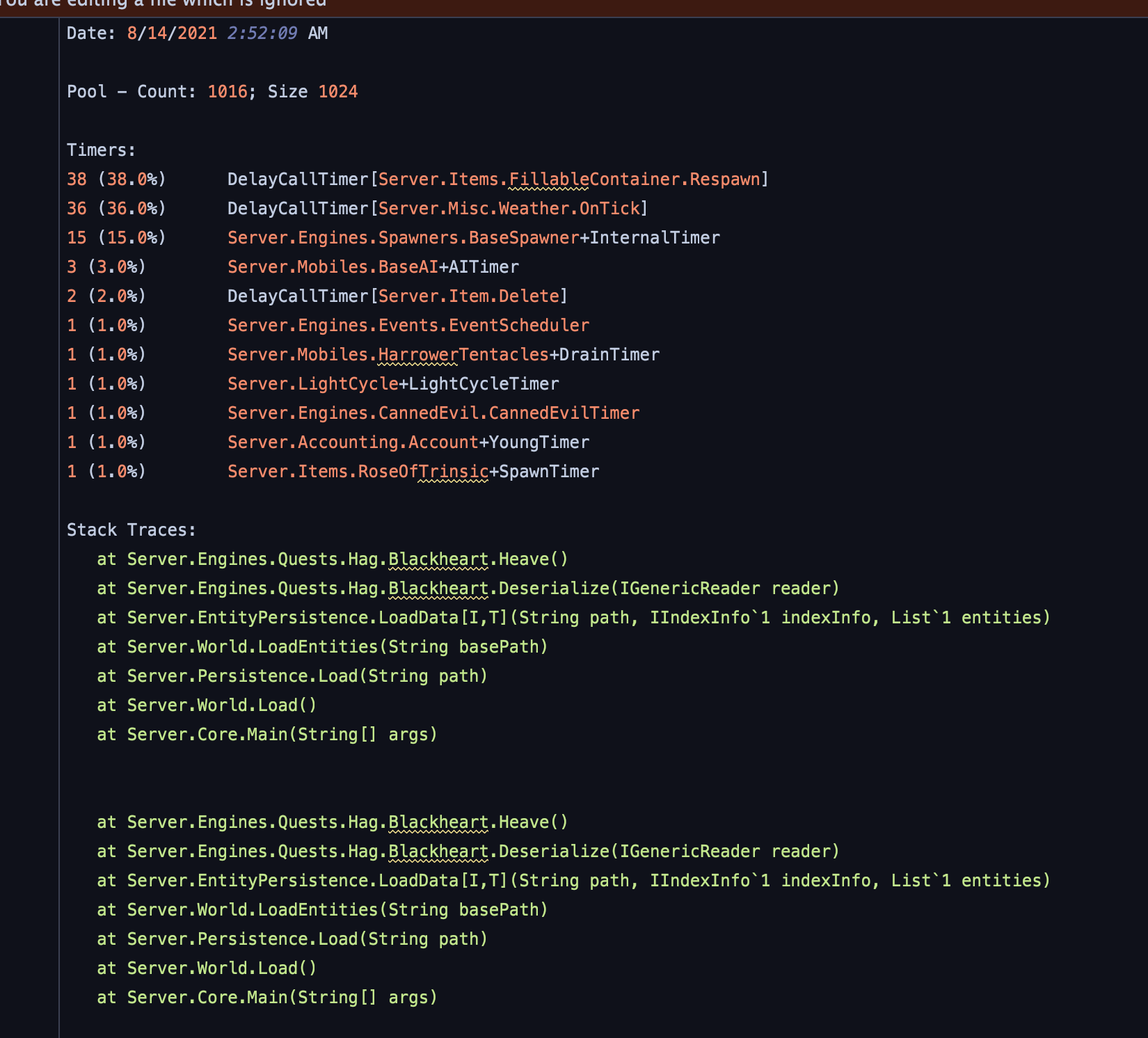
* Fixes `[dumptimers` command so it outputs properly, adds spacing, and stacktraces
* Adds `[Tidy]` for serializing Lists. This will remove deleted entities during world save before serializing the list.
* Adds helpers for managing Lists/Sets/Dictionaries


### New API

```cs
// Creates the list if it is null, then adds
Utility.Add(ref list, value);
Utility.Add(ref set, value);
Utility.Add(ref dict, key, value);

// Nulls the variable if the count is zero
Utility.Remove(ref list, value);
Utility.Remove(ref set, value);
Utility.Remove(ref dict, key);

// Marks entity as dirty in addition to doing the action
entity.Add(list, value);
// Marks entity as dirty, and will create list if it doesn't exist
entity.Add(ref list, value);

// Marks entity as dirty in addition to doing the action
entity.Remove(list, value);
// Marks entity as dirty, and will null the list count is zero
entity.Remove(ref list, value);
```


### Updates to [dumptimers
<img width="825" alt="Screen Shot 2021-08-14 at 2 55 10 AM" src="https://user-images.githubusercontent.com/3953314/129442449-ccf7fe14-29d6-4f3f-9366-c8eb7b9828a7.png">
- [X] Fixes bad `ReadEnum` by size
- [X] Fixes array, list, and set not handling null values properly.
  - It will be up to the user (for now) to null out empty lists using `[AfterDeserialization]`. Convenience may be added later.
- [X] Fixes errors with `dotnet clean` and non-empty generation folder
- [X] Fixes bad field indexes on `Account.cs` causing `tags` to not be serialized/deserialized.
  - This was caused by a duplicate entry. Don't have protection against this _yet_.
- [X] Fixes TimeSpan not working with codegen
- [X] Fixes bad check for generic classes with a serialize method and deserialize ctor
- [X] Moves Accounts to codegen so it is versioned
- [X] Fixes deserialization of old Accounts with no version variable.
- [X] Fixes deserialize seek not doing anything. 🙈
- [X] Adds Email to serialization
Roslyn Source generators are not supposed to access I/O. To get around this we have to use `AdditionalFiles` to give the analyzer access to read/load the schema files.
To write the schema files we have to use a separate program altogether.

- [X] Adds SerializationSchemaGenerator
- [X] Splits out the SerializationGenerator code
After speaking with the C# devs, it is clear that code gen is not ready.
I can get around this by doing the following:
1. Creating a library
2. Splitting out the schema writing from the source generator
3. Moving the schema loading to `AdditionalFiles`
4. Writing a new post-build application using Roslyn to write the schema files after building.
### Additions
- Automatically opts-out `Item/Mobile/Guild/Accounts` from dirty checking with a new property `UseDirtyChecking`
- Codegen now enables `UseDirtyChecking` via getter. This requires that the property is `virtual` for derived types.

### Fixes
- Fixes `EncodedInt` being broken
- Fixes issues with new custom serializable types that are not derived from Item/Mobile/etc.
- Removes double dirty checking.

### Example of a brand new serializable type that isn't an Item/Mobile/etc.
User created code:
```cs
using System;

namespace Server.Items
{
    [Serializable(0)]
    public partial class NewTestEntityObject : ISerializable
    {
        [EncodedInt]
        [SerializableField(0)]
        private int _someProperty;

        public NewTestEntityObject()
        {
            SetTypeRef(GetType());
            // Add to serial tracking like World.Item
            /*
            Serial = World.NewEntity;
            World.AddEntity(this);
            */
        }

        [AfterDeserialization]
        private void AfterDeserialization()
        {
            Console.WriteLine("This ran!");
        }

        public int TypeRef { get; }
        public Serial Serial { get; }
        public void Delete()
        {
        }

        public bool Deleted { get; set; }
        public void SetTypeRef(Type type)
        {
            // Type tracking for persistence goes here
            /*
            TypeRef = World.NewEntityTypes.IndexOf(type);
            if (TypeRef == -1)
            {
                World.NewEntityTypes.Add(type);
                TypeRef = World.NewEntityTypes.Count - 1;
            }
            */
        }
    }
}
```

Generated code:
```cs
namespace Server.Items
{
    public partial class NewTestEntityObject
    {
#pragma warning disable 0414
        private const int _version = 0;
#pragma warning restore 0414

        public int SomeProperty
        {
            get => _someProperty;
            set
            {
                if (value != _someProperty)
                {
                    _someProperty = value;
                    ((ISerializable)this).MarkDirty();
                }
            }
        }

        long ISerializable.SavePosition { get; set; } = -1;
        BufferWriter ISerializable.SaveBuffer { get; set; }
        bool ISerializable.UseDirtyChecking => true;

        public NewTestEntityObject(Serial serial)
        {
            Serial = serial;
            SetTypeRef(typeof(NewTestEntityObject));
        }

        public void Serialize(IGenericWriter writer)
        {

            writer.WriteEncodedInt(_version);

            writer.WriteEncodedInt(SomeProperty);
        }

        public void Deserialize(IGenericReader reader)
        {
            var version = reader.ReadEncodedInt();

            SomeProperty = reader.ReadEncodedInt();

            Timer.DelayCall(AfterDeserialization);
        }
    }
}
```
- [X] Fixes an issue with ordering of properties in serialization.
- [X] Adds opt-in with existing properties.

Example:
```cs
private int _myExistingField;

[SerializableField(1)]
public int MyExistingProperty
{
    get => _myExistingField;
    set
    {
        if (value == 0)
        {
            Parent = null;
        }

        if (value != _myExistingField)
        {
            ((ISerializable)this).MarkDirty();
            _myExistingField = value;
        }
    }
}
```
- [X] Adds Enum migration rule
- [X] Adds legacy version (writing full int for version field)
- [X] Adds encoded int attribute
- [X] Adds intern string attribute
- [X] Fixes missing base deserialize/serialize
### Features
* Fully abstracts serialization by using compile-time attributes.
* Supports serializing the following:
  - Primitives (integers, strings, etc)
  - IP Addresses
  - BigDecimal
  - DateTime, Delta DateTimes
  - TimeSpan
  - Server.Race
  - Server.Map
  - Point2D, Point3D, Rect2D, Rect3D
  - Existing/New `ISerializable` references
  - Lists/Sets of serializable types
  - Type with a `Serialize` method and constructor that takes an `IGenericReader`
* Supports forward-only migration
* Supports existing RunUO deserialization for older versions by changing to the following signature:
  - `public void OldDeserialize(IGenericReader reader, int version)`
  - Must remove deserializing the version since this is already done
* Supports serializing from private fields or custom made properties.
* Types do not require inheriting Item/Mobile. Code gen will fully create `ISerializable` information.
  - This is not recommended yet, since it requires wiring to `Persistence` which will cause lots of unresolved symbol errors until code gen is built.

### Example
```cs
using System.Collections.Generic;

namespace Server.Items
{
    [Serializable(1)]
    public partial class TestItem1 : Item
    {
        [SerializableField(1)]
        [SerializableFieldAttr("[CommandProperty(AccessLevel.Administrator)]")]
        private List<Item> _someProperty;

        private void Deserialize(IGenericReader reader, int version)
        {
        }
    }
}
```

Generates this:
```cs
namespace Server.Items
{
    public partial class TestItem1
    {
#pragma warning disable 0414
        private const int _version = 1;
#pragma warning restore 0414

        [CommandProperty(AccessLevel.Administrator)]
        public System.Collections.Generic.List<Server.Item> SomeProperty
        {
            get => _someProperty;
            set
            {
                if (value != _someProperty)
                {
                    ((ISerializable)this).MarkDirty();
                    _someProperty = value;
                }
            }
        }

        public TestItem1(Serial serial) : base(serial)
        {
        }

        public override void Serialize(IGenericWriter writer)
        {
            var savePosition = ((Server.ISerializable)this).SavePosition;
            if (savePosition > -1)
            {
                writer.Seek(savePosition, System.IO.SeekOrigin.Begin);
                return;
            }
            writer.WriteEncodedInt(_version);
            writer.Write(_someProperty);
        }

        public override void Deserialize(IGenericReader reader)
        {
            var version = reader.ReadEncodedInt();
            if (version < 1)
            {
                OldDeserialize(reader, version);
                ((Server.ISerializable)this).MarkDirty();
                return;
            }
            SomeProperty = reader.ReadEntityList<Server.Item>();
        }
    }
}
```

And this:
```json
{
  "version": 1,
  "type": "TestItem1",
  "properties": [
    {
      "name": "SomeProperty",
      "type": "System.Collections.Generic.List\u003CServer.Item\u003E",
      "rule": "ListMigrationRule",
      "ruleArguments": [
        "Server.Item",
        "SerializableInterfaceMigrationRule"
      ]
    }
  ]
}
```