## Summary

- **Add a self-referencing `InterpolationHandler` to `ValueStringBuilder`** that writes directly into the builder's buffer — zero intermediate allocation, works with `stackalloc`-backed builders
- **Replace all `System.Text.StringBuilder` usage** across the codebase with `ValueStringBuilder`
- **Convert `ValueStringBuilder.Create()` to `stackalloc`** at 10 sites where output length is provably bounded
- **Convert manual `Dispose()` to `using var`** where possible, and hoist loop-scoped builders outside loops with `Reset()`
- **Convert verbose `Append()` chains to `Append($"...")`** interpolation for readability
- **Add comprehensive documentation** for string handling patterns

## InterpolationHandler Design

`ValueStringBuilder` is a `ref struct`, which creates challenges for C#'s interpolated string handler pattern:

- **`ref` fields to ref structs are not allowed** (CS9050)
- **`[InterpolatedStringHandlerArgument("")]` passes struct receivers by value**, not by ref
- **`ISelfInterpolatedStringHandler` requires boxing** ref structs into interface fields

**Solution: Copy-and-reconcile pattern.** The handler receives a value copy of the builder. The copy shares the same underlying `char` buffer (`Span` points to the same `stackalloc`/pooled memory), so writes go to the original buffer. `Append()` reconciles by `this = handler._builder`, updating `_length` and any buffer references changed by `Grow()`.

This is safe because:
- The game loop is single-threaded — no concurrent access between handler construction and reconciliation
- If `Grow()` occurs in the copy, the original's stale buffer isn't accessed until `Append()` replaces it
- `Dispose()` correctly returns the reconciled buffer to the pool

## Changes by Category

### ValueStringBuilder (`Projects/Server/Buffers/ValueStringBuilder.cs`)
- Added nested `InterpolationHandler` ref struct with copy-and-reconcile pattern
- Added `Append([InterpolatedStringHandlerArgument("")] scoped ref InterpolationHandler)` method
- Removed `RawInterpolatedStringHandler` overloads (new handler replaces them)
- All `AppendFormatted` overloads delegate to existing `Append` methods (no code duplication)
- Alignment support via direct private field access (nested type privilege)

### StringBuilder → ValueStringBuilder (15 files)
Replaced all `new StringBuilder()` with `ValueStringBuilder.Create()` or `stackalloc`:
- ConPVP games: KingOfTheHill, DoubleDom, CTF, BombingRun, TourneyMatch
- ConPVP infrastructure: Tournament, Participant, TourneyParticipant
- ConPVP gumps: ArenaGump, TournamentBracketGump, AcceptTeamGump, ConfirmSignupGump
- Commands: Handlers, Logging, Add
- Other: TownCrier, SpeechLogGump, TestCenter

Key patterns:
- `sb = new StringBuilder()` reassignment → `sb.Reset()`
- `sb.AppendFormat("{0:N0}", value)` → `sb.Append($"{value:N0}")`
- `sb.Append(x).Append(y)` chains → separate statements (VSB returns void)

### Create() → stackalloc (10 files)
Converted heap-allocated builders to stackalloc where output is bounded:
- ClientVersion (32), MapSelection (160), HouseRaffleStone (48)
- HolySense (96), UnholySense (96), ClientVerification (192)
- AcceptTeamGump (64), ConfirmSignupGump (64)
- BaseWeapon (160), BaseArmor (128)

### Loop optimizations (2 files)
Hoisted `ValueStringBuilder` creation outside loops with `Reset()` per iteration:
- TourneyMatch.cs: `using var` inside for loop → stackalloc before loop
- ArenaGump.cs: `Create()` + `Dispose()` per iteration → stackalloc before loop

### Append chain → interpolation (5 files)
Converted multi-line `Append()` chains to `Append($"...")`:
- BountyMessage.cs: title switch (6 cases), paragraph (15→1 Append), description lines, closing
- AcceptTeamGump, ConfirmSignupGump, TournamentBracketGump: tournament type strings
- AdminGump: comment/tag formatting in loops

### Documentation
- `dev-docs/string-handling.md`: Full reference — construction, interpolation, disposal, decision guide
- `dev-docs/claude-skills/modernuo-string-handling.md`: Claude skill with quick reference
- `CLAUDE.md`: Added rule 17 (no StringBuilder), dev-docs table entry, skills table entry
- `dev-docs/code-standards.md`: Updated memory management section

## Test Plan

- [x] `dotnet build` — 0 errors, 0 warnings
- [x] `dotnet test` — 940/940 tests pass
- [x] 28 ValueStringBuilder tests covering all reconciliation scenarios:
  - Stackalloc no-grow, stackalloc with grow (→pool transition)
  - Heap no-grow, heap with grow, heap double grow
  - Pre-existing content with and without grow
  - Sequential multiple `Append($"...")` calls
  - Mixed plain + interpolated Append
  - Empty interpolation, literal-only, format specifiers
  - Null string holes, ISpanFormattable types
  - Dispose after stackalloc→pool grow
### Changes/Fixes:
* Adds timer pooling.
* Allows pool to be configurable in ModernUO.json
* Pool replenishes itself asynchronously if depleted.
* Fixes an issue with barkeeps and town criers
* Fixes an issue with incognito buff icons not being removed
* Fixes an issue with polymorph name mod not being removed
* Fixes several places where timers go on forever even after an object is deleted, keeping a reference (memory leak)
* Eliminates the timer for MiningCart altogether.
* Deletes `AcidSlime` since it is a duplicate of `PoolOfAcid`
* Fixes HonorableExecution and standardizes the code for other Bushido moves.

## Changes to the Timer API:
```cs
public class Timer
{
  // Creates a timer that will be returned to the pool once execution stops.
  public static void StartTimer(Action callback);
  public static void StartTimer(TimeSpan delay, Action callback);
  public static void StartTimer(TimeSpan delay, TimeSpan interval, Action callback);
  public static void StartTimer(TimeSpan interval, int count, Action callback);
  public static void StartTimer(TimeSpan delay, TimeSpan interval, int count, Action callback);

  // Creates a timer and returns a token for more control. Requires manual cancellation in order for the timer to be returned to the pool.
  // If the token is dereferenced, the timer will be dereferenced too. While not returning a timer to the pool is not considered hazardous, it does defeat the purpose of pooled timers.
  public static void StartTimer(Action callback, out TimerExecutionToken token);
  public static void StartTimer(TimeSpan delay, Action callback, out TimerExecutionToken token);
  public static void StartTimer(TimeSpan delay, TimeSpan interval, Action callback, out TimerExecutionToken token);
  public static void StartTimer(TimeSpan interval, int count, Action callback, out TimerExecutionToken token);
  public static void StartTimer(TimeSpan delay, TimeSpan interval, int count, Action callback, out TimerExecutionToken token);

  // If you aren't sure how to use the API above, or you don't care about performance, then you can use the old RunUO Timer.DelayCall
  public static DelayCallTimer DelayCall(Action callback);
  public static DelayCallTimer DelayCall(TimeSpan delay, Action callback);
  public static DelayCallTimer DelayCall(TimeSpan delay, TimeSpan interval, Action callback);
  public static DelayCallTimer DelayCall(TimeSpan interval, int count, Action callback);
  public static DelayCallTimer DelayCall(TimeSpan delay, TimeSpan interval, int count, Action callback);
}

public struct TimerExecutionToken
{
  public bool Running { get; }
  public int Index { get; }
  public int RemainingCount { get; }
  public DateTime Next { get; }
}
```

## When to use `TimerExecutionToken`?
Use tokens when you want to gain the performance benefit of using a pooled timer, but you need one of the following:
* Access to the next time the timer will tick:`token.Next`
* Access to which interval, how many intervals there are, or how many are remaining: `token.Index`, `token.Count`, and `token.RemainingCount`
* Stop a timer manually.
* Determine if the timer is running: `timer.Running`
* See notes below about requirements for using tokens!

## Notes about using the TimerExecutionToken:
When you opt-in to receive a token, you must call `Cancel()` to return the timer. This can be done inside of the callback, or outside of the callback at any time.
If this is not called and your timer is an infinite interval, then you will create a potential memory leak, or null pointer exception in your callback.
If the timer ends and is stopped, but cancel is not called, then the timer will never return to the pool and stay referenced until the token is deleted or cancel is called. (Memory leak)

## Is this thread safe?
No. The ModernUO timer system is not thread safe at all. If you require a thread safe timer system, contact me and I'll help adapt this system. Keep in mind that there is a massive performance hit to make this thread safe when there are literally no use cases for it.

If you need to synchronize execution, meaning you want to execute code from another thread on the core thread. Let's say you have a discord bot that is pushing commands to the game server. Then use `EventLoopContext.Post(SendOrPostCallback callback, object state);`.
- [X] Adds a property to `CommandProperty` to allow modifying `PropertyObject` where there is no property setter that is accessible.
- [X] Updates AosAttributes and friends

Example of how to make this work:
```cs
        [CommandProperty(AccessLevel.GameMaster, canModify: true)]
        public AosWeaponAttributes WeaponAttributes { get; private set; }
```

This fix is necessary because in release mode the optimizer will sometimes _entirely remove the setter_ because it knows it can do something that is more efficient _when the property setter is private_. RunUO got around this by declaring a public setter explicitly that _was empty_.

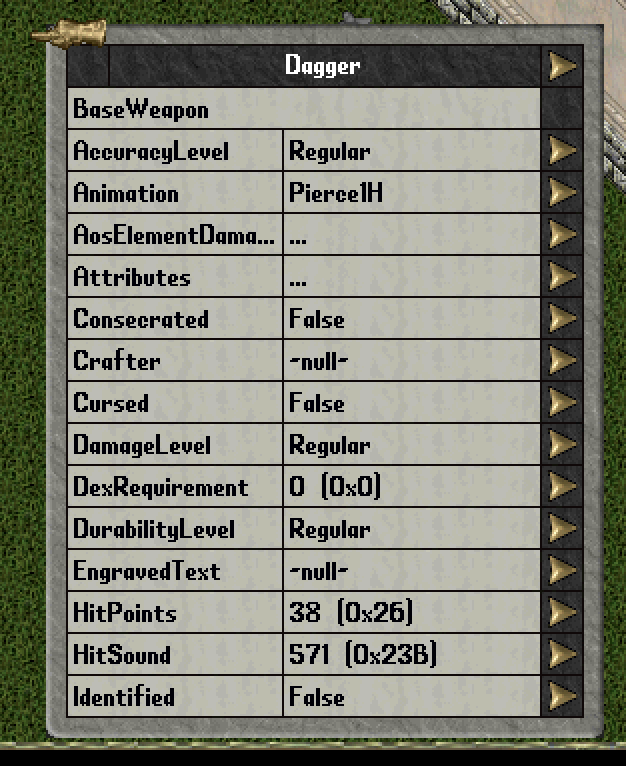
### Screenshot
<img width="313" alt="Screen Shot 2021-05-15 at 11 34 01 PM" src="https://user-images.githubusercontent.com/3953314/118387955-49293c00-b5d6-11eb-8f31-a3b5e31bd18b.png">
- [X] Caches DateTime.NowUtc on the game loop (not other threads)
- [X] Replaces all locations where it makes sense
- [X] Adds Min/Max for `IComparable` (TimeSpan, DateTimes, etc)
Closes#261
- [X] Fixes an issue where a buffer smaller than 8 bytes would not double with enough space in some cases.
- [X] Fixes an issue with dupe copying the savebuffer reference (ugh).
- [X] Streamlines the IGenericWriter API to use better generics.
- [X] Streamlines the IGenericReader API to use better generics.
- [X] Forces `tidying` of a List/HashSet to be done externally since Writers/Readers should not have side effects.
- [X] Fixes an issue where Tidying a list didn't TrimExcess, causing memory leaks.
- [X] Reverted the meaning of `World.Running` to specifically refer to any world state post world loading.
  - NOTE: Do not use this if you want to block on world saves. Instead use checks against `WorldState.Saving` states.
- [X] Fixes an issue with serializing negative DateTime deltas.
- [X] Fixes a potential issue with serializing non-UTC DateTime.

Bumps release version
- [X] Fixes several bugs
- [X] Updates more ordinal issues
- [X] Cleans up the code a bit
- [X] Turns classes static that should have been
- [X] Changes TcpServer.Instances to a HashSet

Bumps release version