## Summary

Consolidates the duplicated inline AOS attribute → `ObjectPropertyList` emission that each item base copy-pastes into per-family `GetProperties(IPropertyList)` methods, mirroring the existing `AosSkillBonuses.GetProperties` precedent.

### Per-family `GetProperties(IPropertyList)`
- **`AosAttributes`** — the 24 common attributes in canonical cliloc-ascending order, with optional `damageBonus` / `hitChanceBonus` / `luckBonus` params so item-computed bonuses (e.g. `GetDamageBonus()`) stay out of the family type.
- **`AosWeaponAttributes`** — `UseBestSkill`, the `Hit*` block (1060416–1060430), `MageWeapon` (`30 - prop`), `SelfRepair`.
- **`AosArmorAttributes`** — `MageArmor`, `SelfRepair` (the always-direct members; `LowerStatReq`/`DurabilityBonus` stay inline since they're item-computed in armor but container-direct in clothing).

### Rewired all 6 `AosAttributes`-emitting item bases
`BaseJewel`, `BaseArmor`, `BaseClothing`, `BaseWeapon`, `BaseTalisman`, `Spellbook` now call the family methods instead of inlining the chain. Net: large dedup in `BaseWeapon`/`BaseArmor`/`BaseClothing`/`BaseTalisman`/`Spellbook`.

## Behavior change: tooltip line **order** (set preserved)

This is **not** a pure no-op refactor, and that's unavoidable. Today the families are emitted **interleaved in cliloc order**, and the relative order differs per item class — e.g. `BonusDex` (1060409) is emitted early in `BaseArmor` but **after** the `Hit*` block in `BaseWeapon`. No single emission order reproduces every class byte-for-byte, so consolidating into contiguous per-family blocks necessarily **de-interleaves**: lines regroup **specific → general** (family-specific, then common `AosAttributes`).

- The **set** of emitted `(cliloc, argument)` lines per item is preserved **exactly** — nothing dropped, added, or value-changed.
- Only the **order** of lines within a tooltip changes for `BaseArmor` / `BaseWeapon` / `BaseClothing`. `BaseJewel` / `BaseTalisman` / `Spellbook` were already canonical, so those are byte-identical.

## Tests
- **Golden set-invariance tests** per item base (`BaseArmor/Clothing/Jewel/Weapon/Talisman/Spellbook PropertiesTests`) — each was written to pass against current `main` **before** the rewire (locking the emitted-line set), then confirmed still passing after, proving no line is lost/added/changed.
- Family-level unit tests for each `GetProperties` (canonical order, computed-bonus folding, the `AosArmorAttributes` exclusions).
- `dotnet build` clean; full `UOContent.Tests` green. (Pre-existing `AccountPacket`/`GumpPacket`/`MobilePacket`/`ClientEnumerator` golden-test failures reproduce on unmodified `main` and are unrelated to this change.)
## Summary

Adds authentic **T2A-era (pre-UO:Third-Dawn) packet-based crafting menus**, enabled via the **`t2aCraftMenus` server setting** (read once at startup; default **`!Core.UOTD`**, so a pre-UO:TD shard gets them automatically). When enabled, double-clicking a crafting tool opens the classic `0x7C`/`0x7D` item-list menu — skill- and material-filtered — instead of the modern gump, covering all 8 tool/skill crafts (blacksmithy, tailoring, tinkering, carpentry, alchemy, bowcraft/fletching, inscription, cartography). It is **not** a runtime/admin-flippable feature flag.

This is the **definitive, reconciled** branch and **supersedes**:
- **#2181** (Delphi — `T2A_CraftingMenus`): the original effort.
- **#2381** (Jack/UOLL — `t2a_crafting_menus`): the research-grounded superset (Delphi's base + 12 corrections), rebased onto current `main`.

Original authorship is preserved across the cherry-picked history: foundation commit **@Delphi79**, mechanic fixes **@jackuoll (Jack Ward)**, reconciliation/fixes/docs mine.

## How it was built

1. Cherry-picked Jack's 13 commits onto current `main` (superset of Delphi's; only 2 trivial FeatureFlags conflicts).
2. Applied targeted fixes (below) with tests.
3. Full convention audit, build, and test pass.

Grounded in independent historical research plus Jack's deep dive. Maintainer reference: `dev-docs/t2a-crafting.md`.

## Mechanics (highlights)

- Double-click tool → target resource → skill/material-filtered menu → craft. Resource pre-selection per skill; make-last by targeting the tool.
- **Stacked-gem jewelry:** target a gem stack → the **full stack** is consumed and the piece is named by count ("a 1000 diamond ring"); count persists (`BaseJewel` serialization **v4 → v5**, new `_gemCount`).
- **Tool-less inscription & cartography** (skill-list invoked; no pen/sextant); inscription consumes reagents+scroll on success and failure, mana only on success.
- **Tailoring matching-hue consumption:** targeting hued cloth/leather consumes only that hue. Crafted items take color from their **`CraftResource`** (not the dyed hue), so dyed leather/cloth don't tint the product; in T2A only colored ingots/ore color items (metal armor/shields).
- **Half-resources on failed non-scroll crafts** (pre-UO:TD).
- **Maker's mark** always prompted for exceptional items, via the shared `QueryMakersMarkGump`.
- Server-side menu infra changes are additive (`ItemListEntry.CraftIndex`, `Entries` setter, `HasSent`).

## Notable changes on top of the cherry-pick

- **Toggle is a startup server setting, not a feature flag.** Removed `ContentFeatureFlags.T2ACraftMenus` (and its admin-flippable plumbing); the value is read once via `ServerConfiguration.GetSetting("t2aCraftMenus", !Core.UOTD)` into `T2ACraftSystem.Enabled`. Since the default tracks the era and it can't be flipped at runtime, there's no incoherent "menus-on / UO:TD-era" state.
- **Stacked-gem consumption (B3a/B3):** consume the full `PendingGemCount` (was deliberately consuming 1 while naming by the stack), null-safe gem type, plain-piece fallback + message. New `T2AJewelGemCraftTests`.
- **Convention audit:** `new List<Item>()` → `PooledRefList<Item>` on the hue-aware consume path; removed dead code.

## Decisions & deviations

- `make-last` kept as **QoL** (post-T2A gump-era feature).
- `half-on-failure` (non-scroll) kept as a **reconstruction** (not OSI-confirmed).
- **Stacked-gem** behavior set per shard authority (overrides the "single gem" reconstruction).
- **Cooking** out of scope (no T2A crafting menu existed for it).
- **No colored items from dyed materials:** crafted color comes from the `CraftResource` type. Pre-AOS leather has no colored variant, so leather is always uncolored; weapons retain resource color only in AOS+ (unchanged, intended).

## Test plan

- Automated: `dotnet build ModernUO.slnx -c Debug` clean; `dotnet test Projects/UOContent.Tests` → **421 passed** (incl. 3 new jewelry tests).
- Manual (needs a running T2A shard + client):
  - [ ] Each of the 8 skills opens the correct menu; empty-menu guard fires.
  - [ ] Make-last repeats the last craft (jewelry re-prompts gem).
  - [ ] Jewelry consumes the full targeted gem stack and names by count.
  - [ ] Cartography consumes blank maps only with T2A enabled / maps+scrolls when disabled.
  - [ ] Tailoring consumes only the targeted-hue material; crafted items are not tinted by dyed cloth/leather.
  - [ ] Maker's-mark prompt on exceptional.
  - [ ] Failed non-scroll craft consumes half resources.
  - [ ] Inscription: reagents+scroll on success/failure, mana only on success.
  - [ ] T2A disabled: gump crafting unchanged.

## Credits

Co-authored-by: @Delphi79
Co-authored-by: @jackuoll
## Summary

### Changes
- Adds `[IgnoreDupe]` and `[SerializedIgnoreDupe]`
- Updates all _known_ classes that need the attribute. Some might be missing, please helps us find them!
- Adds `Item.Dupe()` command and encapsulates `CopyProperties` and `OnAfterDuped`. This is also overridable.
- Updates Dupe command to use the new logic.
- Fixes duping multiple kinds of objects that used to be outright broken.

### Bug Fixes
- Fixes issue with durability after duping
- Fixes issue with hue after duping

> [!Note]
> **Developer Note**
> Customizing how duping an item works now requires two steps:
> 1. Add `[IgnoreDupe]` or `[SerializedIgnoreDupe]` to the property/field
> 2. Add custom logic in an `OnAfterDuped` override
>
> When do you need to do this?
> *When the property being copied is not a primitive, and you need to manually deep-clone the contents of the property such as with Lists, Dictionaries, or sub classes.*
* Adds `SerializationProperty` - This will generate the private variable for serialization. Also provides an option `useField` to specify your own. Example:
  ```cs
  [SerializationProperty(0, useField: nameof(_resource)]
  ```
## Changes
- [X] Adds OPL convenience methods
    - `opl.Add(cliloc, value)` and `opl.Add(value)` - value as an integer or string works just like `opl.Add(cliloc, $"{value}")`
    - `opl.AddLocalized(cliloc, clilocValue)` - works the same as `opl.Add(cliloc, $"#{clilocValue}");`
- [X] Simplifies basic `list.Add()` situations
- [X] Changes cliloc as an argument so it works with custom IPropertyList implementations (HTML)
- [X] Fixes plants so they support the old localization and new (changed in 7.0.12.0+)
- [X] Exposes more methods to override for Item to make creating custom OPL possible.

## Important Notes
* Using a ternary as an argument, like this `opl.Add(number, showType ? $"{type}\t{value}" : $"{value}");` _will not use the correct string interpolation_. This means if you use a custom PropertyList (for HTML or some other purpose), the property list won't be localized properly.
* All localization values must be interpolated, even if they are literal strings, or integers. Example: `opl.Add(number, $"{"Charges"}\t{m_Charges}");` is correct. Using the following: `$"Charges\t{m_Charges}"` will not work for custom PropertyList implementations!
## Breaking Changes (New API)
ObjectPropertyList supports the following API:
```cs
list.Add(500000);
list.Add(500001, stringArgument);
list.Add("Some text");
list.Add($"Some text with {argument}");
list.Add(500002, $"{arg1}\t{arg2}");
```

## Notes
1. All API uses that require a formatter like this:
    ```cs
    list.Add(500002, "{0}\t{1}", arg1, arg2);
    ```
    Should be changed to use string interpolation, for example:
    ```cs
    list.Add(500002, $"{arg1}\t{arg2}");
    ```
2. The following paradigm should no longer be used:
    ```cs
    list.Add(1061170, prop.ToString()); // strength requirement ~1_val~
    ```
    The new string interpolation API will avoid having to convert the argument to a string before writing it to the packet. Instead use the following:
    ```cs
    list.Add(1061170, $"{prop}"); // strength requirement ~1_val~
    ```

### Benchmarks
```cs
|                         Method |     Mean |   Error |  StdDev |  Gen 0 | Allocated |
|------------------------------- |---------:|--------:|--------:|-------:|----------:|
|                BenchmarkOldOPL | 241.0 ns | 0.56 ns | 0.47 ns | 0.0105 |      88 B |
| BenchmarkStringInterpolatedOPL | 199.9 ns | 2.44 ns | 2.39 ns |      - |         - |
```

### Changes
- [X] Removes crash in STArray.Return when array is null.
- [X] Fixes NPE in OPL when entity is null. Serial in packet will be 0 when entity is null.
- [X] Fixes NPE in AosAttributes when Parent is null.
- [X] Changes OPL to use string interpolation.
- [X] Introduces `IPropertyList` to allow extending PropertyList for other uses.
* Adds save flag support (see `ElvenGlasses` for an example)
* Updates AOSAttributes so they are code genned
* Fixes embedded object support by adding an `IRawSerializable`
* Fixes various inconsistencies in serializing with codegen
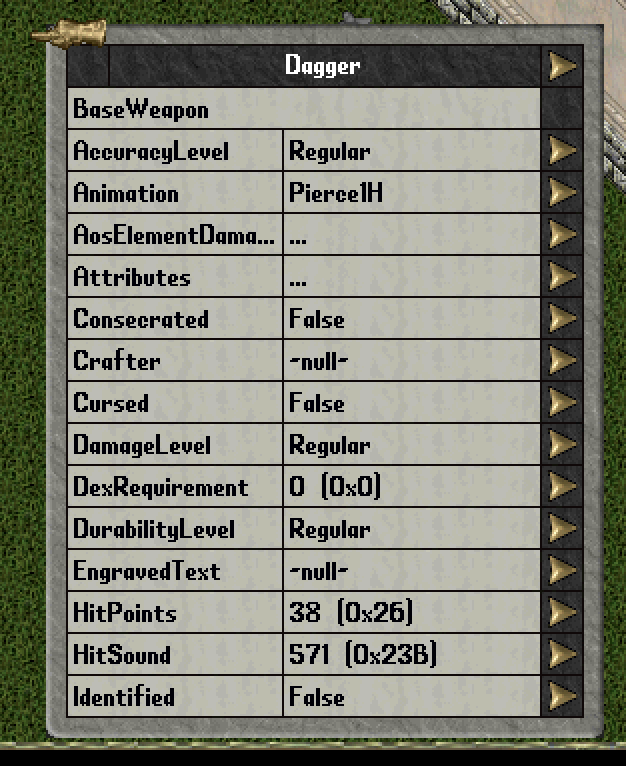
- [X] Adds a property to `CommandProperty` to allow modifying `PropertyObject` where there is no property setter that is accessible.
- [X] Updates AosAttributes and friends

Example of how to make this work:
```cs
        [CommandProperty(AccessLevel.GameMaster, canModify: true)]
        public AosWeaponAttributes WeaponAttributes { get; private set; }
```

This fix is necessary because in release mode the optimizer will sometimes _entirely remove the setter_ because it knows it can do something that is more efficient _when the property setter is private_. RunUO got around this by declaring a public setter explicitly that _was empty_.

### Screenshot
<img width="313" alt="Screen Shot 2021-05-15 at 11 34 01 PM" src="https://user-images.githubusercontent.com/3953314/118387955-49293c00-b5d6-11eb-8f31-a3b5e31bd18b.png">