## Problem

`RunEventLoop` span through its body regardless of whether there was anything to do — ~10% of a desktop core for an empty shard, and ~70% of a core on a 3 vCPU VPS. A process that never idles is exactly what burstable vCPU plans throttle, which is how this surfaced: lag spikes that went away when the operator bought more cores. The spin also denied the GC its natural pause points, so memory climbed until a world save forced a collection — alarming in task manager, harmless in practice, and a recurring source of "is my server leaking?" reports.

## Result

Windows desktop, real world of **190,728 items / 33,158 mobiles**, no players, saves and prebake off, three consecutive runs:

| | Legacy spin | Idle sleeping |
|---|---|---|
| **CPU** | 10.42 – 10.50% of one core | **0.78 – 1.00%** |
| **Tick lag** (peak/15s) | 4–10 ms | 5–11 ms |

**~10× less CPU with tick lag unchanged** — the CPU came free rather than being traded for latency. Slower hosts gain proportionally more. Spin mode (`server.eventLoopIdleWaitMs=0`) independently gained **7× the iterations per core** (1.19M → 8.3M cycles/sec) from the ring's AcceptEx rework.

## How

The loop blocks in `NetState.WaitForCompletion` whenever every queue it drains is empty (all the drains are bounded, so leftovers keep it awake). Receive completions, new connections, and cross-thread `LoopContext.Post` (via the ring's sticky `Wake()`) are all in the wait set, so sleeping adds no latency to any of them. Only timer-driven logic sees wheel lag, bounded by the idle wait.

**Health is measured at the only place sleeping can cause harm.** A sleep is bounded by the time to the next wheel turn, so a correctly honoured sleep can never miss a deadline — the only failure mode is the host returning the wait late. That overshoot is measured on every sleep (one extra timestamp read; production's entire accounting cost), and an escalating backoff suspends sleeping when it persists. By construction, server work — saves, heavy staff commands, deep timer callbacks — cannot trip it, so the warning means exactly one thing: *the host is not scheduling the process promptly*, with two known remedies (dedicated CPU, or `=0`). Hosts with no high-resolution wait mechanism at all are detected once at startup and spin instead.

**CPS is removed.** `Core.CyclesPerSecond`/`AverageCPS` measured nothing actionable before and became actively misleading once the loop sleeps (the rate is set by the sleep, not by shard health). The admin gump's Performance page now shows the verdict instead: `Healthy` / `Sleep suspended (host)` / `Spinning (configured)`.

## Configuration

| Setting | Default | Meaning |
|---|---|---|
| `server.eventLoopIdleWaitMs` | `2` | Longest idle block. Measured across 1/2/4/8 ms, 2 is where the trade stops being free. `0` = never sleep: ~98% of a core, zero scheduling overhead — for large shards on dedicated CPU. |
| `server.lateWakeThreshold` | `1` | Idle waits the host may return a full tick late, per second, before sleeping backs off. Raise for jittery hosts; very high disables the backoff. |

## Diagnostics (compiled out by default)

`dotnet build -p:EventLoopProfiling=true` compiles in `EventLoopProfiler` — every hook is `[Conditional("EVENT_LOOP_PROFILING")]`, so normal builds contain zero profiling IL. The profiling build decomposes each second of wall time into **work (per loop phase) / sleep / GC pause / stolen residual**, keeps ~15 minutes of history in a ring buffer, and the `[LoopStats` command prints the last minute and dumps the full history to CSV. `dev-docs/debugging-event-loop.md` is the diagnosis guide (for humans and AI): what production already tells you, when to flip the profiling build, the signature table for host-steal vs deep-processing vs GC vs wake bugs, why dotnet-trace comes last, and the GC/RAM "leak" misconception.

## Verification

- 815 Server.Tests green; both build configurations compile.
- Docker echo harness green on epoll and io_uring (ping-pong mode); kqueue verified manually on an M1 Max.
- A/B measurements and per-change numbers: `measure/event-loop` branch.

## Notes

The full measurement harness and vendored ring sources used to develop this live on the [`measure/event-loop`](https://github.com/modernuo/ModernUO/tree/measure/event-loop) branch, kept for future loop work.
## Why

The shard owner, on a Starlink CGNAT address, was blocked by the imported reputation blocklist.

The cause was not CrowdSec. The address was a literal line in `ip-blocklist.txt`, so `BlocklistFilter` denied it at accept and then promoted it — and clearing the CrowdSec decision could not fix it either, because the file entry re-reports within `promoteSuppression` of every reconnect attempt.

This is structural, not a one-off. Reputation feeds list shared consumer address space constantly: on CGNAT one public address fronts many subscribers **at the same time**, so a single abusive customer gets the address listed and everyone else behind it is blocked with them. Where leases rotate, a listing says little about whoever holds the address now. Around 1,000 Starlink addresses sit in the current list.

So exemptions go where they cost nothing, and escalation is driven by what a connection actually does.

## Generator — `tools/Export-IpBlocklist.ps1`

`-AllowlistFile` takes multiple paths, subtracted from the merged set before the output is written. Defaults to every `ip-allowlist*.txt` beside the output, merged into one allow set:

- `ip-allowlist.txt` — operator exemptions, created once and **never rewritten**
- `ip-allowlist-<name>.txt` — a carve-out you built, regenerable and copyable between shards

**Subtraction is range-correct.** An allowlisted address inside a blocked CIDR splits that CIDR around the hole rather than being silently ignored. This also fixes `-ExcludeAnonymizers`, which parsed CIDR entries into `$anonCidr` and then only ever subtracted singles.

**No carve-out ships.** A carve-out names a real network, and which ones a shard should exempt depends on where its players actually are — so publishing one would make that policy call for every shard and put a specific provider's address space in the repo. The script builds them on request instead:

```powershell
.\Export-IpBlocklist.ps1 -AddCarveout starlink -Asn 14593
```

Carve-outs are **discovered, not configured**: every `ip-allowlist*.txt` beside the output is subtracted, by the generator and by the shard, so a file an admin adds needs no config edit and no code change. Each carries an `asn=` marker in its header, which is how `-RefreshCarveouts` rebuilds it without the script keeping a list of anyone's networks; a hand-written allowlist has no marker and is never rewritten.

Prefixes come from **announcements, not ownership records**, because registry data disagrees with what is actually routed and silently caps result sets: ARIN whois returns at most 256 rows and gives per-customer /24s, and `206.83.96.0/19` reads as APNIC in RDAP even though `206.83.96/21` is announced by Starlink.

Editing an allowlist bypasses `-MinInterval`, so a just-added exemption isn't indistinguishable from the allowlist not working. A Starlink carve-out, if you build one, costs **~4,300 IPs + ~144 CIDRs of 4.2M (0.10%)**.

## Allowlists

**`FileAllowlist`** reads the same files the generator subtracts, so an operator entry means "leave this address alone" for real. Subtraction alone only covers being *blocked*; behavioural detections never consult the blocklist, so without this a carve-out was quietly routed around — one scanner behind a shared address was enough to get everyone behind it contributed and firewalled, with nothing in the shard's own config explaining why. Reading the files also means an entry applies on the next reload rather than the next regeneration, which is what matters when someone is complaining now.

**`LoginAllowlist`** is earned by authenticating, with a 90-day TTL because an address that logged in years ago is a stranger. Its own store rather than `Account.LoginIPs`, which has no timestamps and cannot be backfilled. An entry is evidence rather than a licence: 10 suppressed contributions in an hour revokes it, and a fresh login forgives the tally.

Both are consulted **only after the blocklist has already matched**, so a normal accept pays nothing for them and the accept gate stays allowlist-free. `BanExemptions` combines them behind `BanChannel.IsExempt` and suppresses escalation only — every local defence still applies.

Two limits, both deliberate and documented in the class: `LoginAllowlist` **cannot bootstrap** (an entry is only earned by getting in, so it never repairs an existing false positive), and it is weakest on rotating CGNAT. That is why `FileAllowlist` is the fix for those, and why it is manual.

## Behavioural detection

| Reason | Trigger |
|---|---|
| `silent-connect` | Reaped after 5s having sent **zero bytes** |
| `invalid-seed` | Opened with a zero seed |
| `foreign-protocol` | Positively identified as HTTP, TLS or SSH |

**`ForeignProtocol` inverts the test.** Asking "is this a good UO client?" cannot work: `LoginEncryption.ClientDecrypt` is a byte-for-byte stream XOR, so a legitimate client with encryption enabled when the shard expects none sends a structurally perfect connection whose payload is noise. "Speaks HTTP" is safe where "unreadable" is not — however misconfigured a UO client is, it never sends `GET / HTTP/1.1`.

Nothing assumes arrival framing. TCP has no message boundaries, so a rule of the form "these bytes must arrive together" is broken by construction and drops real players on poor links. A prefix match with too few bytes to confirm waits for more. A four-byte seed can legitimately spell `GET ` (the address 71.69.84.32) or `0x16 0x03 0x0?` (22.3.x.x), so confirmation requires the request line to continue in printable ASCII or an actual ClientHello inside a plausible record — a real client's fifth byte is a packet id (`0x80`, `0x91`, `0xEF`), none of them printable, so those collisions fall through.

Everything is keyed on **bytes-received rather than elapsed time**. A connection that sent something and ran out of time is far more likely a slow link than an attack, and banning those produces the worst failure mode available: the player retries, trips the rate limiter, and compounds a bad connection into hours of being firewalled off.

## `AutoDenylist`

A short-lived local hold (15m) on behavioural detections, as `IConnectionFilter` + `IBanReporter` over one store so the engine detection sites never reach into content.

This closes the gap where a flood pays for a socket, buffer and `NetState` slot per connection while waiting for the OS bouncer — the verdicts that matter most are reachable only *after* reading bytes — and it is the entire defence on a shard running no bouncer, which is the default config. Not persisted: a holding pen that survives restarts is a ban without a ban's review.

Cost: one dictionary lookup on a usually-empty dict per accept.

## `BanReasons`

Centralises the reason slugs. `IsBehavioral` is an **opt-in** set, not "everything except manual", so a future reason escalates normally instead of silently inheriting an exemption or entering a local denylist.

This caught a real bug during review: the first cut of the exemption swallowed `manual` admin bans (`Commands.cs`, three sites in `AdminGump`) for any allowlisted address.

## Fixes found in review

- **`BanConfiguration.Settings` was null until `Configure()` ran**, while the reap path dereferences it every `Slice()`. A harness driving `NetState.Slice()` directly hit an NRE that presented as flaky because it depended on whether an earlier test had already called `Configure()` — which is why it failed on some CI platforms and not others. Now starts at the record's defaults, with idempotency tracked by a flag; this also removes the same latent NRE from the pre-existing rate-limit path.
- **`-AllowlistFile` was typed `[string]`** while documented and used as a list, so passing two paths would have collapsed them into one string.

## Layout and docs

Content network code moves out of `Misc/` into `UOContent/Network/`, one concern per folder — `AutoDenylist/`, `Blocklist/`, `CrowdSec/`, `Firewall/`, `LoginAllowlist/`, `Packets/`. **Namespaces are untouched**, so these are pure file moves (git tracks all 16 as renames).

`dev-docs/ip-bans-and-allowlists.md` documents the subsystem, leading with the operator process for unblocking a player — including the three things that look sufficient and are not: deleting the CrowdSec decision alone, editing `ip-blocklist.txt` by hand, and `cscli allowlists` alone. `.gitignore` covers the new config files.

## Testing

Build clean. **Server.Tests 810 passed**, **UOContent.Tests 637 passed**, zero warnings. This branch adds 38 tests; the rest of the delta is main's, since this is rebased on current `main`.

New coverage: TTL boundary and renewal, private-address exclusion, manual-ban-never-exempt, unopted-reason-never-exempt, strike revocation, quiet-window reset, login forgiveness, file-allowlist CIDR coverage, file-allowlist not spending the earned list's strikes, denylist expiry-on-read, cap enforcement, lapsed-entry reclaim, HTTP/TLS/SSH identification, seed-collision fall-through, and encrypted-login-is-not-foreign.

Generator verified end-to-end against live feeds: a clean run ships no carve-out, `-AddCarveout starlink -Asn 14593` fetches and collapses 213 prefixes to 115 ranges in 0.1s over 4.2M entries, `-RefreshCarveouts` rediscovers it by its `asn=` marker, a hand-written allowlist is left untouched, and deleting a carve-out drops it rather than having it rewritten. CIDR splitting verified exhaustively: a single-IP hole in a /24 leaves exactly 255 of 256 addresses blocked.

## Operator note

Existing installs are unaffected until the generator next runs, which creates `ip-allowlist.txt` and nothing else. To unblock someone: add the address to that file and delete any live CrowdSec decision — the existing ban outlives the config change. The shard picks the entry up on its next reload, so re-running the generator is optional.

A shard whose players are on CGNAT (satellite, mobile, or an ISP short on IPv4) will likely also want `-AddCarveout`; see `dev-docs/ip-bans-and-allowlists.md`.

## Also included: a latent CI failure this PR surfaced

`fix(tests): serialize test classes that rent through STArrayPool` touches a property-list test file that has nothing to do with this feature. It is here because it was failing macOS CI, and it is trivially cherry-pickable out if you would rather it went to `main` on its own — **which may be the better call, since it is failing `main` today.**

CI has since gone green with it applied.

`STArrayPool` is single-threaded by design and its bucket cache is a plain `static`, not `[ThreadStatic]`, with a check-then-act initialize in `Return()`:

```csharp
var cacheBuckets = _cacheBuckets ?? InitializeBuckets();
```

Two threads both see null, both initialize, and the loser trips `Debug.Assert(_cacheBuckets is null)`. Anything renting from it has to stay off parallel test threads — which is what the `DisableParallelization` collections are for.

- `ObjectPropertyListReentrancyTests` and `ObjectPropertyListNestedBuildTests` (added in #2555) build property lists, which rent the interpolation buffer, but were not in the sequential collection — unlike `PropertyListInvalidationDuringBuildTests` in the same file. This is a **latent failure already on `main`**; it is timing-dependent, so it shows on some platforms and not others.
- `AutoDenylistTests` (added here) has the same exposure: its cap tests reach `AutoDenylist.Sweep`, which rents a `PooledRefList` without `mt`. The blocklist tests need no marking because `BlocklistSnapshot.Build` asks for the `mt` pool explicitly.

No production change — `STArrayPool` is the right pool on the game loop, where both `Sweep` and the property list actually run.

## Deliberately not included

Waiting for a fragmented four-byte seed at `AwaitingSeed`. It looked like a bug but the disconnect is a deliberate defence: only pre-0xEF clients reach it (0xEF goes through `HandlePacket`, which already waits for its 21 bytes), and waiting converts an instant drop into a full 5s slot hold for a client sending one or two bytes, or a loris dribbling a byte every few seconds. Against a fixed 4096-entry `MaxConnections` table that trades capacity that matters for a fragmentation case a reconnect already fixes.
Reshapes IP banning around one idea: **core owns the question, content owns every answer.**

Core gains a single accept-path seam — `IConnectionFilter` — and loses everything that used to implement one. The firewall moves to UOContent, a new file-backed blocklist joins it there, and CrowdSec is repositioned from an in-app enforcer to a contribute-first reporter.

## The seam

```csharp
public interface IConnectionFilter
{
    string Name { get; }
    void Configure();
    void Start(CancellationToken token);
    void Stop();
    bool ShouldDeny(IPAddress address);
}
```

The accept path went from hardcoded branches to one question:

```csharp
else if (ConnectionFilters.ShouldDeny(remoteIP, out var deniedBy))
{
    logger.Debug("{Address} denied by connection filter '{Filter}'", remoteIP, deniedBy);
}
```

Filters register during the Configure sweep. The registry is a plain array walked by an indexed loop — no enumerator, no closure, no allocation — and the first denial short-circuits. An interface dispatch is noise next to the `accept()` syscall, so pluggability costs nothing measurable on the path that has to survive a DDoS.

Whatever a hit implies — persisting, promoting to an OS bouncer, contributing to the ban channel — is the filter's business, not the accept path's.

A filter that throws is **unregistered and the connection fails open**. A filter that faults once faults for every subsequent connection, so leaving it registered means an exception and a log line per accept — exactly the amplification an attacker wants — and a broken filter must not be able to deny everyone either.

This deliberately does **not** reuse `EventSink.InvokeSocketConnect`: that fires later and allocates a `SocketConnectEventArgs` per connection, which is what the accept path avoids for rejected traffic.

## What ships behind it

**`firewall`** (UOContent) — the existing admin-curated set. Collapsed from `Firewall` + `AdminFirewall` + a threaded enforcer into one single-threaded store with **zero concurrency primitives**: the accept path, admin gump, TTL expiry and boot load all run on the game loop. Persists to `Configuration/firewall.json` with automatic migration from the legacy `firewall.cfg`. No behavior change for operators — same namespace, same gump, same commands.

**`blocklist`** (UOContent) — new. Holds a millions-strong list in-app and **demand-pages** hits up to CrowdSec, which promotes them to the OS firewall.

The motivation is concrete: CrowdSec's Windows bouncer cannot load the ~3.9M IPs that 91 community feeds produce, but it handles ~100k fine. So the millions live in-process behind a binary search, and only addresses that *actually connect* get promoted. A `PromotedGuard` suppresses re-reporting an address until the bouncer picks it up.

The list is parsed straight from UTF-8 file bytes with no per-line string allocation, off the game loop, and published as an immutable snapshot swapped through a single `volatile` reference. Reloads yield to world saves.

**`tools/Export-IpBlocklist.ps1`** — the producer. Requires PowerShell 7 and runs on Windows, Linux and macOS; Windows PowerShell 5.1 is refused up front via `#requires`. Merges a thin, non-overlapping feed set into one de-duplicated, bogon-filtered file. Parsing runs in a compiled `Add-Type` hot loop (~1s for ~4M lines instead of minutes). Written to a `.tmp` sibling and swapped with `File.Replace`, so the shard never reads a half-written list, and a total feed outage refuses to overwrite a good list with an empty one. Re-running is idempotent — it exits without downloading anything while the list on disk is younger than `-MinInterval` (default 2h, the anchor feed's own refresh period), so a misconfigured scheduler can't hammer upstream.

## CrowdSec: contribute-first

`IBanReporter` + `BanChannel` fan locally-decided bans out to external systems. `CrowdSecReporter` (UOContent) posts to LAPI `POST /v1/alerts` and retracts via `DELETE /v1/decisions`.

Reporting is **enqueue-only** on the accept path: a bounded, coalescing channel drained off-loop with bounded retry, counted drops on overflow, and a flush on shutdown. Under a DDoS the accept path never does synchronous or lock-contending per-IP work.

### Why not pull decisions from CrowdSec?

The original design streamed decisions into an in-app snapshot and enforced them at the accept gate. That's the wrong layer: by the time the shard sees the connection, the TCP handshake and socket setup are already paid for. `cs-firewall-bouncer` drops the same traffic **at the kernel**, and it's what CrowdSec is built to do. So the shard now contributes what it uniquely knows (rate-limit trips, blocklist hits from real connection attempts) and lets the OS enforce.

The one thing the OS can't do — hold millions of entries on Windows — is exactly what the in-app blocklist covers, and it feeds the same pipeline.

## Threading policy

`CLAUDE.md` rule #3 is rewritten as an explicit three-part policy, with rule #10 restated in tandem:

- Anything touching game state runs **only** on the main loop.
- Heavy work that *needs* game state must be **chunked** across ticks, never threaded.
- Heavy work that does *not* need game state (large-file parse, external I/O) **must** run off-loop **and must yield to world saves**.

Results come back via an immutable snapshot swapped through a single `volatile` reference, or `Core.LoopContext.Post` — never by letting the scheduler decide where heavy work runs. Both new subsystems follow it.

## Shared primitives

`SortedRangeIndex<T> where T : IBinaryInteger<T>` — coalesced disjoint interval arrays plus a binary search. The firewall, the blocklist, and (as of this PR) core's reserved-network tables all use it.

Coalescing is a correctness requirement, not an optimization: multi-feed lists nest CIDRs (`/24` containing a `/32`), and a search that inspects only the rightmost run whose minimum is ≤ the value is sound **only** over disjoint runs. That bug was caught in review and is covered by regression tests.

`IPAddressUtility` collects the allocation-free `IPAddress` ↔ `UInt128` conversions and CIDR parsing that were previously scattered or duplicated.

## Config

| File | Owner | Keys |
|---|---|---|
| `Configuration/bans.json` | core | `reportRateLimitTrips`, `autoBanDuration` |
| `Configuration/blocklist.json` | content | `file`, `reloadInterval`, `reportHits`, `banDuration`, `promoteSuppression` |
| `Configuration/crowdsec.json` | content | `lapiUrl`, `machineId`, `password`, `origin`, `manualBanDuration`, `flushInterval`, `maxQueue` |
| `Configuration/firewall.json` | content | persisted firewall entries (migrated from `firewall.cfg`) |

Everything is inert by default. CrowdSec self-disables without credentials; the blocklist self-disables until its file exists. A shard that changes nothing sees no behavior change.

## Notes for review

- **Core no longer references `Firewall` or `IFirewallEntry` anywhere.** `NetworkUtilities` used to build its reserved-network tables out of `CidrFirewallEntry`, which coupled core to the firewall for something unrelated to banning; those are now a `SortedRangeIndex<UInt128>`, same semantics and public API.
- **`BanChannel.Stop()` no longer persists the firewall** — a contribution coordinator has no business saving an enforcement store. That's the firewall filter's `Stop()`.
- **A dead `whitelisted` parameter was dropped** from the blocklist gate: it was hardcoded `false` at its only call site, and no whitelist concept exists in core.
- **The blocklist filter is an instance, not a static.** The static version forced its tests onto the sequential collection with a reset hook; they now run in parallel.
- `dev-docs/networking-packets.md` documents the seam for content authors, plus a known wart in the `IPAddress` ↔ `UInt128` normalization flagged for a follow-up PR.
- The generator was verified on Linux, macOS and Windows under a temporary CI matrix (since removed). It caught two portability bugs — a Windows-only path separator, and a culture-sensitive duration parse that read `2.5` as `25` on comma-decimal locales and *silently* turned a 2.5h cooldown into 25h — plus a third that made the script unparseable on Windows PowerShell 5.1. The source is ASCII-only for that last reason: `#requires` is only honored once a file parses, so non-ASCII in a BOM-less script produces parse errors instead of the version message.

## Tests

**1344 pass** (782 `Server.Tests`, 562 `UOContent.Tests`). New coverage: filter registry (registration, short-circuit, fault-disable), blocklist parsing/CIDR/coalescing, snapshot reload markers, promote-guard TTL, ban-channel fan-out, CrowdSec alert building/dedup/flush-on-stop, and the generator's output-format contract pinned against the reader.
## Summary

Replaces the basic `publish.cmd`/`publish.sh` scripts with an interactive **BuildTool** — a C# console app using [Spectre.Console](https://spectreconsole.net/) that guides users through publishing, prerequisite checking, and cross-compilation.

### Why
The community found the existing publish scripts unhelpful for newcomers. They worked but didn't walk users through the process, didn't check prerequisites, and provided no feedback when things went wrong.

### What's New

**Interactive BuildTool** (`Projects/BuildTool/`)
- NativeAOT-compiled C# console app with true-color ASCII logo and ModernUO brand gold/silver palette
- Guided publish wizard with step-by-step back navigation (Ctrl+C or menu "Back" to go to previous step)
- Prerequisite checking: .NET SDK version, VC++ Redistributable (Windows), native libraries (Linux/macOS)
- .NET SDK auto-install offer via Microsoft's official install scripts
- Platform detection: Windows 10 vs 11 (build number), macOS codenames, Linux distro + kernel version
- Cross-compilation support: skips native library checks, shows target prerequisites after build
- Non-interactive mode for CI: `--config Release --skip-prereqs`
- Backward-compatible positional args: `publish.cmd release win x64` still works

**Shell Wrappers** (`publish.cmd`, `publish.ps1`, `publish.sh`)
- Try native BuildTool binary first (downloaded from GitHub Releases)
- Fall back to `dotnet run --project Projects/BuildTool` if unavailable
- SDK bootstrapping: offer to install .NET if not found

**CI/CD Updates**
- Build/test workflows target `Projects/Application/Application.csproj` instead of the solution (excludes BuildTool and test projects from publish)
- New `build-tool-release.yml` workflow builds NativeAOT binaries for win-x64, win-arm64, osx-arm64, linux-x64, linux-arm64
- Minimum SDK bumped to 10.0.201 (required for Serialization Generator 2.14.3 / Roslyn 5.3.0)

**Other Changes**
- Solution converted from `.sln` to `.slnx`
- Updated README with interactive mode instructions and deployment guidance

## Screenshots

<img width="320" height="378" alt="image" src="https://github.com/user-attachments/assets/83c057c5-3992-4dbd-99fa-0e3c24ef6428" />

<img width="749" height="554" alt="image" src="https://github.com/user-attachments/assets/e4ee4d6f-71d4-47f9-86b6-8fd1ca3c3e7a" />
Summary

  - Adds CLAUDE.md at repo root with 14 terse code audit rules (always loaded, low token cost)
  - Adds pointer files for other AI tools: AGENTS.md (Codex), GEMINI.md, .github/COPILOT-INSTRUCTIONS.md (Copilot), .cursorrules (Cursor) — all redirect to CLAUDE.md as single source of truth
  - Gitignores /.claude so personal AI config isn't distributed
  - Moves Claude skills to dev-docs/claude-skills/ (opt-in, not auto-loaded)
  - Adds 14 dev-docs covering codebase conventions

  Code Audit Rules (in CLAUDE.md)

  1. LINQ tiered rules (Tier 1 free, Tier 2 warm, Tier 3 forbidden)
  2. No Console.WriteLine — use LogFactory.GetLogger()
  3. No concurrency primitives in game code
  4. No World.Mobiles/World.Items iteration
  5. Clean up refs in OnDelete()/OnAfterDelete()
  6. Cancel timers in OnDelete()/OnAfterDelete()
  7. STArrayPool<T>.Shared not ArrayPool<T>.Shared
  8. PooledRefList<T> not new List<T>() on hot paths
  9. Serialization: partial class, [Constructible], no serialized TimerExecutionToken
  10. No Task.Run/new Thread() in game code
  11. Never assume era — ask which expansion
  12. _camelCase fields, PascalCase properties/methods
  13. No empty gumps — use DisplayTo() pattern
  14. PropertyList string literals must be {} holes, cliloc-as-argument uses :#
> [!Note]
> **Developer Note**
> Now developers will only need to build/run the Application project instead of everything.
> When adding new projects, make sure to:
> 1. Add a reference to that project in the Application project.
> 2. Add the dll file to the Distribution/Data/assemblies.json file

### Summary
- Adds an application project
- Consolidates process restarts to use `Core.Kill(true)`
- Removes some old messaging, for example processor optimization
- Fixes missing build cleanup
### Summary

- Fixes `[AdvancedSearch` being accessible by players 😱
- Adds `[GenCommands` to generate the same commands html page on https://muo.gg/commands.
- Fixes `[helpinfo` so all commands properly show up!

> [!WARNING]
> ### Developer Warning:
> Commands must now be registered in the `Configure` bootup phase.
> If a command is not registered early enough, it may not be available to systems like [helpinfo
> that cache their information.

> [!NOTE]
> ### Developer Note:
> Various commands related to generating content have been changed to _Developer_ and above access level.

### Screenshots
<img width="673" alt="image" src="https://github.com/modernuo/ModernUO/assets/3953314/b105b5c9-5eb4-4ace-93ff-1bfb31e7132f">

<img width="547" alt="image" src="https://github.com/modernuo/ModernUO/assets/3953314/e97487e8-47a5-4aa7-89cc-9fe3deda584d">
## Adds Auto Archiving
Backups are archived once an hour, day, and month. Archives older than 60 days are pruned automatically.

_Note: Automatic pruning is off by default_

### Archive compression format
The following formats are supported:
* Zstd (The fastest with best compression ratio)
* GZip
* Zip
* None (Tar)

_Note: By default archives use [zstandard](http://facebook.github.io/zstd/) format.
The archive format can be changed in modernuo.json `autoArchive.compressionFormat`_

### Restoring world from archive
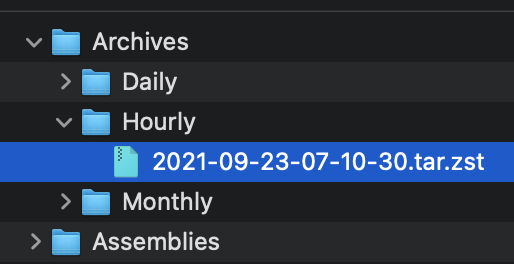
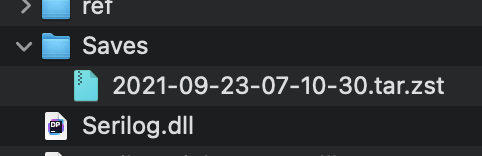
Move the archive to the Saves folder (tar.zst file). On startup the server will extract the file and restore the latest save. See pictures below.

### Manually extracting an archives
#### Windows
* Use the latest version of [7-zip w/ ZStandard](https://github.com/mcmilk/7-Zip-zstd/releases/latest)
  1. Extract the `.tar.zst` file.
  2. Extract the `.tar` file. (Yes you have to do it in two steps)
* On Windows 10 you can use the command line. `zstd.exe` is in the Assemblies folder after building ModernUO.
  1. `tar --use-compress-program "Distribution\Assemblies\zstd.exe -d" -xvf "Archives\Hourly\archivefile.tar.zst" -C "path to where you want to extract it"`
#### Mac
* Install [Keka](https://www.keka.io)
  1. Drop the .tar.zst onto the keka interface.
#### Linux
  1. Install zstd from a package manager
  2. Run `tar -I zstd -xvf "Archives\Hourly\archivefile.tar.zst" -C "path to where you want to extract it"`

### Other changes
* Changes Autosave to occur at the same time no matter when the server is booted.
* Adds `[SaveFrequency <delay> [warning]`command to set save frequency and warning frequency in-game.
* Adds support for time zones that are configurable. The system timezone can also be manually configured. Check `TimeZoneHandler.cs` for details.

<img width="257" alt="Screen Shot 2021-09-22 at 11 23 18 PM" src="https://user-images.githubusercontent.com/3953314/134464929-a5bf3cd8-2ef0-4476-a9ad-71d0816a19ac.png">
<img width="241" alt="Screen Shot 2021-09-22 at 11 23 39 PM" src="https://user-images.githubusercontent.com/3953314/134464945-5f6f96dc-3d1e-434d-8256-5c6b3705e786.png">
<img width="836" alt="Screen Shot 2021-09-22 at 11 34 39 PM" src="https://user-images.githubusercontent.com/3953314/134464957-625e57f2-ef47-4ca1-a0a7-cd40c9b6539c.png">
<img width="631" alt="Screen Shot 2021-09-22 at 11 34 50 PM" src="https://user-images.githubusercontent.com/3953314/134464969-b2d65c0d-f8f5-497a-a832-5d805e8e0b22.png">
### Features
* Fully abstracts serialization by using compile-time attributes.
* Supports serializing the following:
  - Primitives (integers, strings, etc)
  - IP Addresses
  - BigDecimal
  - DateTime, Delta DateTimes
  - TimeSpan
  - Server.Race
  - Server.Map
  - Point2D, Point3D, Rect2D, Rect3D
  - Existing/New `ISerializable` references
  - Lists/Sets of serializable types
  - Type with a `Serialize` method and constructor that takes an `IGenericReader`
* Supports forward-only migration
* Supports existing RunUO deserialization for older versions by changing to the following signature:
  - `public void OldDeserialize(IGenericReader reader, int version)`
  - Must remove deserializing the version since this is already done
* Supports serializing from private fields or custom made properties.
* Types do not require inheriting Item/Mobile. Code gen will fully create `ISerializable` information.
  - This is not recommended yet, since it requires wiring to `Persistence` which will cause lots of unresolved symbol errors until code gen is built.

### Example
```cs
using System.Collections.Generic;

namespace Server.Items
{
    [Serializable(1)]
    public partial class TestItem1 : Item
    {
        [SerializableField(1)]
        [SerializableFieldAttr("[CommandProperty(AccessLevel.Administrator)]")]
        private List<Item> _someProperty;

        private void Deserialize(IGenericReader reader, int version)
        {
        }
    }
}
```

Generates this:
```cs
namespace Server.Items
{
    public partial class TestItem1
    {
#pragma warning disable 0414
        private const int _version = 1;
#pragma warning restore 0414

        [CommandProperty(AccessLevel.Administrator)]
        public System.Collections.Generic.List<Server.Item> SomeProperty
        {
            get => _someProperty;
            set
            {
                if (value != _someProperty)
                {
                    ((ISerializable)this).MarkDirty();
                    _someProperty = value;
                }
            }
        }

        public TestItem1(Serial serial) : base(serial)
        {
        }

        public override void Serialize(IGenericWriter writer)
        {
            var savePosition = ((Server.ISerializable)this).SavePosition;
            if (savePosition > -1)
            {
                writer.Seek(savePosition, System.IO.SeekOrigin.Begin);
                return;
            }
            writer.WriteEncodedInt(_version);
            writer.Write(_someProperty);
        }

        public override void Deserialize(IGenericReader reader)
        {
            var version = reader.ReadEncodedInt();
            if (version < 1)
            {
                OldDeserialize(reader, version);
                ((Server.ISerializable)this).MarkDirty();
                return;
            }
            SomeProperty = reader.ReadEntityList<Server.Item>();
        }
    }
}
```

And this:
```json
{
  "version": 1,
  "type": "TestItem1",
  "properties": [
    {
      "name": "SomeProperty",
      "type": "System.Collections.Generic.List\u003CServer.Item\u003E",
      "rule": "ListMigrationRule",
      "ruleArguments": [
        "Server.Item",
        "SerializableInterfaceMigrationRule"
      ]
    }
  ]
}
```
- [X] Fixes map issues at New Haven by turning off static diffs
- [X] Some code cleanup and reformatting of tile matrix, tile matrix patch, and tile data
- [X] Adds NetState.Flush for generating spawners so it doesn't feel like the server is frozen
- [X] Reverts NativeReader changes from a while back.
- [X] Adds more string reading for BufferReader.


Notes:
BufferReader is still `little endian` compared to `SpanReader` which is `big endian` (for packets). To that end, the RunUO deserialization `ReadString()` was made obsolete since it is ambiguous, and contains extra fields other than simply reading a string. Furthermore, we shouldn't be using UTF8 (for now) since it is slow.
## Breaking Change
* IP Matching no longer supports `?` (e.g. you cannot do: "192.16?.0.1")
* IP Matching no longer supports `*` and other values in the same section (e.g. you cannot do "192.1\*.0.1")
  * To do "192.1\*.0.1", you should use the range option with three separate entries: "192.100-199.0.1", "192.1.0.1", "192.10-19.0.1"

## Non-Breaking Changes
- [X] Adds IPv6 support (not for servers though, just clients)
- [X] Adds interning support for IPv4 mapped to IPv6
- [X] Updates IPv4ToAddress (don't use this unless you know it is IPv4 or IPv4 mapped to IPv6)

## Note:
UO Does not support IPv6 for the server. To support an IPv6 server IP you will need to use CUO or some kind of custom client and probably modify it accordingly.

Bumps release version