* Adds `RaceFlag` to the `Race` object. This is `1 << RaceIndex`
* Replaces `RequiredRace`  with `RequiredRaces` for items.
* Adds convenience flags for `RequiredRaces`
  ```cs

  public const int AllowAllRaces = 0x7;      // Race.Human.RaceFlag | Race.Elf.RaceFlag | Race.Gargoyle.RaceFlag
  public const int AllowHumanOrElves = 0x3;  // Race.Human.RaceFlag | Race.Elf.RaceFlag
  public const int AllowElvesOnly = 0x2;     // Race.Elf.RaceFlag
  public const int AllowGargoylesOnly = 0x4; // Race.Gargoyle.RaceFlag
  ```
* Example usage on an item:
  ```cs
  public override int RequiredRaces => Race.AllowHumanOrElves;
  ```
* Adds Wood and Stone armor material types
* Updates Woodland armor to Wood
* Adds proper messaging for race restrictions
* Adds gargoyle only for object properties
* Adds `CheckRace` functions for validating if a race or mobile can use the item:
  ```cs
  bool CheckRace(Race race);
  bool CheckRace(Mobile from, bool message = true);
  ```
* Removes BodyValue
* Removes BodyPicker gump
* Fixes setting Body and BodyMod in props gump
* Props will now look for an `implicit cast` in order to find a way to allow you to modify values with the props gump.
* Fixed `[self set body 0x190` so it works too.
* Fixed an issue where a timer truncated the link list.
* Fixed an issue where a timer stopped and started itself within an OnTick causing it to remove itself from the link list, but still think it's running.
* Adds save flag support (see `ElvenGlasses` for an example)
* Updates AOSAttributes so they are code genned
* Fixes embedded object support by adding an `IRawSerializable`
* Fixes various inconsistencies in serializing with codegen
* Adds code genning for embedded objects. See `AquariumState` as an example.
* Adds code genning for fields that are `Timer`. See `Aquarium` as an example.
* Codegens aquariums
* Fixes missing option for most primitive field types.
* Fixes pooled timer leaking
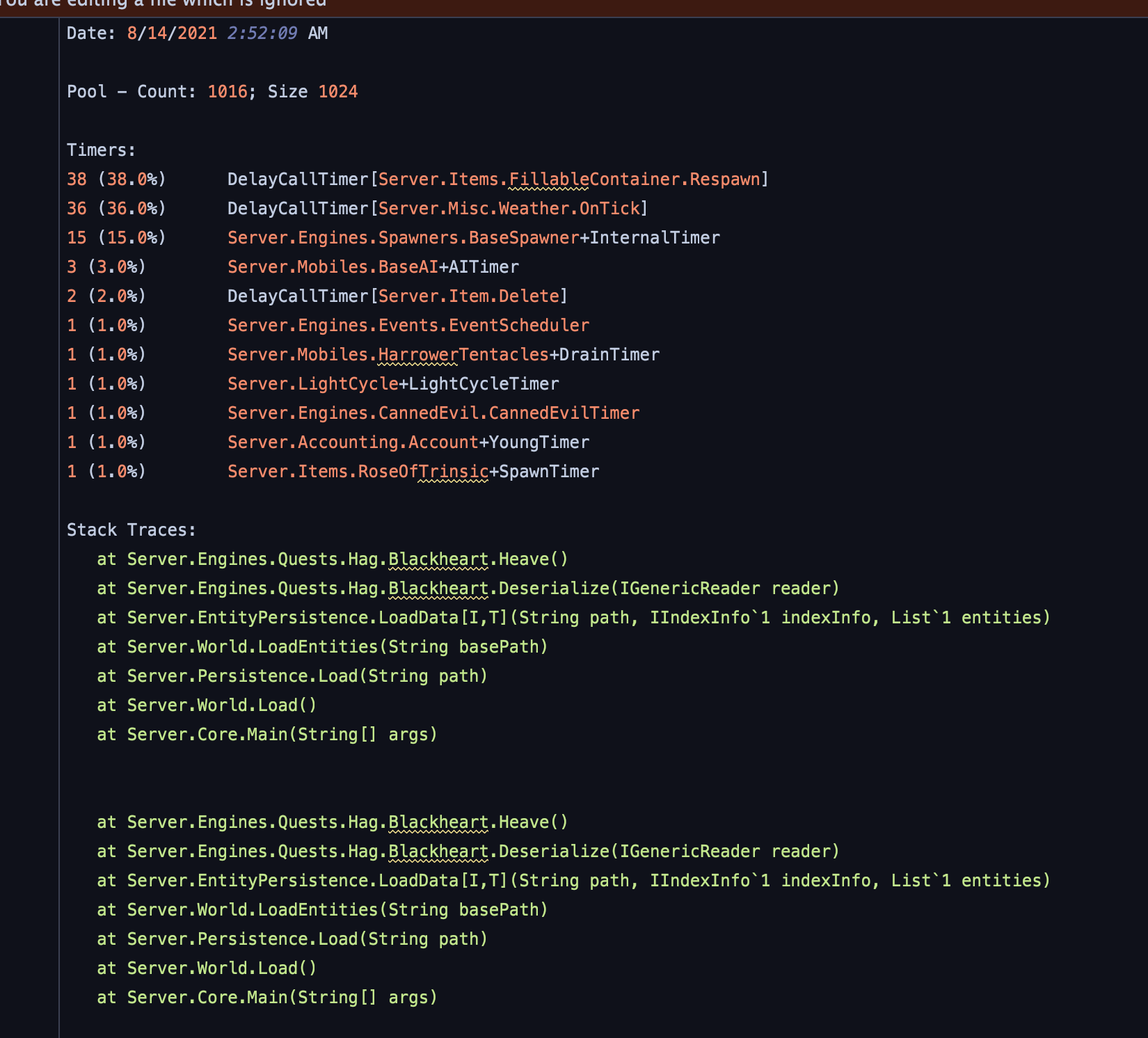
* Fixes `[dumptimers` command so it outputs properly, adds spacing, and stacktraces
* Adds `[Tidy]` for serializing Lists. This will remove deleted entities during world save before serializing the list.
* Adds helpers for managing Lists/Sets/Dictionaries


### New API

```cs
// Creates the list if it is null, then adds
Utility.Add(ref list, value);
Utility.Add(ref set, value);
Utility.Add(ref dict, key, value);

// Nulls the variable if the count is zero
Utility.Remove(ref list, value);
Utility.Remove(ref set, value);
Utility.Remove(ref dict, key);

// Marks entity as dirty in addition to doing the action
entity.Add(list, value);
// Marks entity as dirty, and will create list if it doesn't exist
entity.Add(ref list, value);

// Marks entity as dirty in addition to doing the action
entity.Remove(list, value);
// Marks entity as dirty, and will null the list count is zero
entity.Remove(ref list, value);
```


### Updates to [dumptimers
<img width="825" alt="Screen Shot 2021-08-14 at 2 55 10 AM" src="https://user-images.githubusercontent.com/3953314/129442449-ccf7fe14-29d6-4f3f-9366-c8eb7b9828a7.png">
* Optimizes OrderedHashSet using the learnings here: https://github.com/dotnet/runtime/issues/10050
* Removes ValueCollection since it was a relic from the conversion of the OrderedDictionary
* Centralizes throw strings.
* Adds pooled ordered hash set (but doesn't use it)
Closes#448
### Changes/Fixes:
* Adds timer pooling.
* Allows pool to be configurable in ModernUO.json
* Pool replenishes itself asynchronously if depleted.
* Fixes an issue with barkeeps and town criers
* Fixes an issue with incognito buff icons not being removed
* Fixes an issue with polymorph name mod not being removed
* Fixes several places where timers go on forever even after an object is deleted, keeping a reference (memory leak)
* Eliminates the timer for MiningCart altogether.
* Deletes `AcidSlime` since it is a duplicate of `PoolOfAcid`
* Fixes HonorableExecution and standardizes the code for other Bushido moves.

## Changes to the Timer API:
```cs
public class Timer
{
  // Creates a timer that will be returned to the pool once execution stops.
  public static void StartTimer(Action callback);
  public static void StartTimer(TimeSpan delay, Action callback);
  public static void StartTimer(TimeSpan delay, TimeSpan interval, Action callback);
  public static void StartTimer(TimeSpan interval, int count, Action callback);
  public static void StartTimer(TimeSpan delay, TimeSpan interval, int count, Action callback);

  // Creates a timer and returns a token for more control. Requires manual cancellation in order for the timer to be returned to the pool.
  // If the token is dereferenced, the timer will be dereferenced too. While not returning a timer to the pool is not considered hazardous, it does defeat the purpose of pooled timers.
  public static void StartTimer(Action callback, out TimerExecutionToken token);
  public static void StartTimer(TimeSpan delay, Action callback, out TimerExecutionToken token);
  public static void StartTimer(TimeSpan delay, TimeSpan interval, Action callback, out TimerExecutionToken token);
  public static void StartTimer(TimeSpan interval, int count, Action callback, out TimerExecutionToken token);
  public static void StartTimer(TimeSpan delay, TimeSpan interval, int count, Action callback, out TimerExecutionToken token);

  // If you aren't sure how to use the API above, or you don't care about performance, then you can use the old RunUO Timer.DelayCall
  public static DelayCallTimer DelayCall(Action callback);
  public static DelayCallTimer DelayCall(TimeSpan delay, Action callback);
  public static DelayCallTimer DelayCall(TimeSpan delay, TimeSpan interval, Action callback);
  public static DelayCallTimer DelayCall(TimeSpan interval, int count, Action callback);
  public static DelayCallTimer DelayCall(TimeSpan delay, TimeSpan interval, int count, Action callback);
}

public struct TimerExecutionToken
{
  public bool Running { get; }
  public int Index { get; }
  public int RemainingCount { get; }
  public DateTime Next { get; }
}
```

## When to use `TimerExecutionToken`?
Use tokens when you want to gain the performance benefit of using a pooled timer, but you need one of the following:
* Access to the next time the timer will tick:`token.Next`
* Access to which interval, how many intervals there are, or how many are remaining: `token.Index`, `token.Count`, and `token.RemainingCount`
* Stop a timer manually.
* Determine if the timer is running: `timer.Running`
* See notes below about requirements for using tokens!

## Notes about using the TimerExecutionToken:
When you opt-in to receive a token, you must call `Cancel()` to return the timer. This can be done inside of the callback, or outside of the callback at any time.
If this is not called and your timer is an infinite interval, then you will create a potential memory leak, or null pointer exception in your callback.
If the timer ends and is stopped, but cancel is not called, then the timer will never return to the pool and stay referenced until the token is deleted or cancel is called. (Memory leak)

## Is this thread safe?
No. The ModernUO timer system is not thread safe at all. If you require a thread safe timer system, contact me and I'll help adapt this system. Keep in mind that there is a massive performance hit to make this thread safe when there are literally no use cases for it.

If you need to synchronize execution, meaning you want to execute code from another thread on the core thread. Let's say you have a discord bot that is pushing commands to the game server. Then use `EventLoopContext.Post(SendOrPostCallback callback, object state);`.
**Note for Rider users** Code generation only works with Rider v2021.1+. For Rider 2021.1.x you must set a global msbuild attribute so that the IDE can recognize generated code after building. JetBrains claims this will be fixed in Rider 2021.2.

**Rider 2021.1 Required Setting for Code Generation**
<img width="945" alt="Screen Shot 2021-07-19 at 9 36 30 PM" src="https://user-images.githubusercontent.com/3953314/126262725-a4d58dd0-e9e0-400f-a172-0b29ef7a00d7.png">

**Note for VS 2019+ users**: Code generation requires completely cleaning your solution, doing a full build, closing VS 2019, and then opening the solution. This is a known issue and there are no plans to fix this multiple restart requirement for VS 2022 at this time.
- [X] Fixes bad `ReadEnum` by size
- [X] Fixes array, list, and set not handling null values properly.
  - It will be up to the user (for now) to null out empty lists using `[AfterDeserialization]`. Convenience may be added later.
- [X] Fixes errors with `dotnet clean` and non-empty generation folder
- [X] Fixes bad field indexes on `Account.cs` causing `tags` to not be serialized/deserialized.
  - This was caused by a duplicate entry. Don't have protection against this _yet_.
- [X] Fixes TimeSpan not working with codegen
- [X] Fixes bad check for generic classes with a serialize method and deserialize ctor
- [X] Moves Accounts to codegen so it is versioned
- [X] Fixes deserialization of old Accounts with no version variable.
- [X] Fixes deserialize seek not doing anything. 🙈
- [X] Adds Email to serialization
Roslyn Source generators are not supposed to access I/O. To get around this we have to use `AdditionalFiles` to give the analyzer access to read/load the schema files.
To write the schema files we have to use a separate program altogether.

- [X] Adds SerializationSchemaGenerator
- [X] Splits out the SerializationGenerator code
After speaking with the C# devs, it is clear that code gen is not ready.
I can get around this by doing the following:
1. Creating a library
2. Splitting out the schema writing from the source generator
3. Moving the schema loading to `AdditionalFiles`
4. Writing a new post-build application using Roslyn to write the schema files after building.
- Adds `[ManualDirtyChecking]` for anyone that adds it themselves.
- Adds detection of `[Serializable]` and `[ManualDirtyChecking]` at startup to help identify scripts that need migration.
### Additions
- Automatically opts-out `Item/Mobile/Guild/Accounts` from dirty checking with a new property `UseDirtyChecking`
- Codegen now enables `UseDirtyChecking` via getter. This requires that the property is `virtual` for derived types.

### Fixes
- Fixes `EncodedInt` being broken
- Fixes issues with new custom serializable types that are not derived from Item/Mobile/etc.
- Removes double dirty checking.

### Example of a brand new serializable type that isn't an Item/Mobile/etc.
User created code:
```cs
using System;

namespace Server.Items
{
    [Serializable(0)]
    public partial class NewTestEntityObject : ISerializable
    {
        [EncodedInt]
        [SerializableField(0)]
        private int _someProperty;

        public NewTestEntityObject()
        {
            SetTypeRef(GetType());
            // Add to serial tracking like World.Item
            /*
            Serial = World.NewEntity;
            World.AddEntity(this);
            */
        }

        [AfterDeserialization]
        private void AfterDeserialization()
        {
            Console.WriteLine("This ran!");
        }

        public int TypeRef { get; }
        public Serial Serial { get; }
        public void Delete()
        {
        }

        public bool Deleted { get; set; }
        public void SetTypeRef(Type type)
        {
            // Type tracking for persistence goes here
            /*
            TypeRef = World.NewEntityTypes.IndexOf(type);
            if (TypeRef == -1)
            {
                World.NewEntityTypes.Add(type);
                TypeRef = World.NewEntityTypes.Count - 1;
            }
            */
        }
    }
}
```

Generated code:
```cs
namespace Server.Items
{
    public partial class NewTestEntityObject
    {
#pragma warning disable 0414
        private const int _version = 0;
#pragma warning restore 0414

        public int SomeProperty
        {
            get => _someProperty;
            set
            {
                if (value != _someProperty)
                {
                    _someProperty = value;
                    ((ISerializable)this).MarkDirty();
                }
            }
        }

        long ISerializable.SavePosition { get; set; } = -1;
        BufferWriter ISerializable.SaveBuffer { get; set; }
        bool ISerializable.UseDirtyChecking => true;

        public NewTestEntityObject(Serial serial)
        {
            Serial = serial;
            SetTypeRef(typeof(NewTestEntityObject));
        }

        public void Serialize(IGenericWriter writer)
        {

            writer.WriteEncodedInt(_version);

            writer.WriteEncodedInt(SomeProperty);
        }

        public void Deserialize(IGenericReader reader)
        {
            var version = reader.ReadEncodedInt();

            SomeProperty = reader.ReadEncodedInt();

            Timer.DelayCall(AfterDeserialization);
        }
    }
}
```
- [X] Fixes an issue with ordering of properties in serialization.
- [X] Adds opt-in with existing properties.

Example:
```cs
private int _myExistingField;

[SerializableField(1)]
public int MyExistingProperty
{
    get => _myExistingField;
    set
    {
        if (value == 0)
        {
            Parent = null;
        }

        if (value != _myExistingField)
        {
            ((ISerializable)this).MarkDirty();
            _myExistingField = value;
        }
    }
}
```
Added the ability to execute arbitrary code after deserialization.

Example, let's say you want to delete an item after you deserialize it:
```cs
        [AfterDeserialization]
        private void OnAfterDeserialization()
        {
            Delete();
        }
```

Generates this:
```cs
        public override void Deserialize(IGenericReader reader)
        {
            base.Deserialize(reader);

            var version = reader.ReadEncodedInt();

            Timer.DelayCall(OnAfterDeserialization);
        }
```