* Adds save flag support (see `ElvenGlasses` for an example)
* Updates AOSAttributes so they are code genned
* Fixes embedded object support by adding an `IRawSerializable`
* Fixes various inconsistencies in serializing with codegen
* Fixes pooled timer leaking
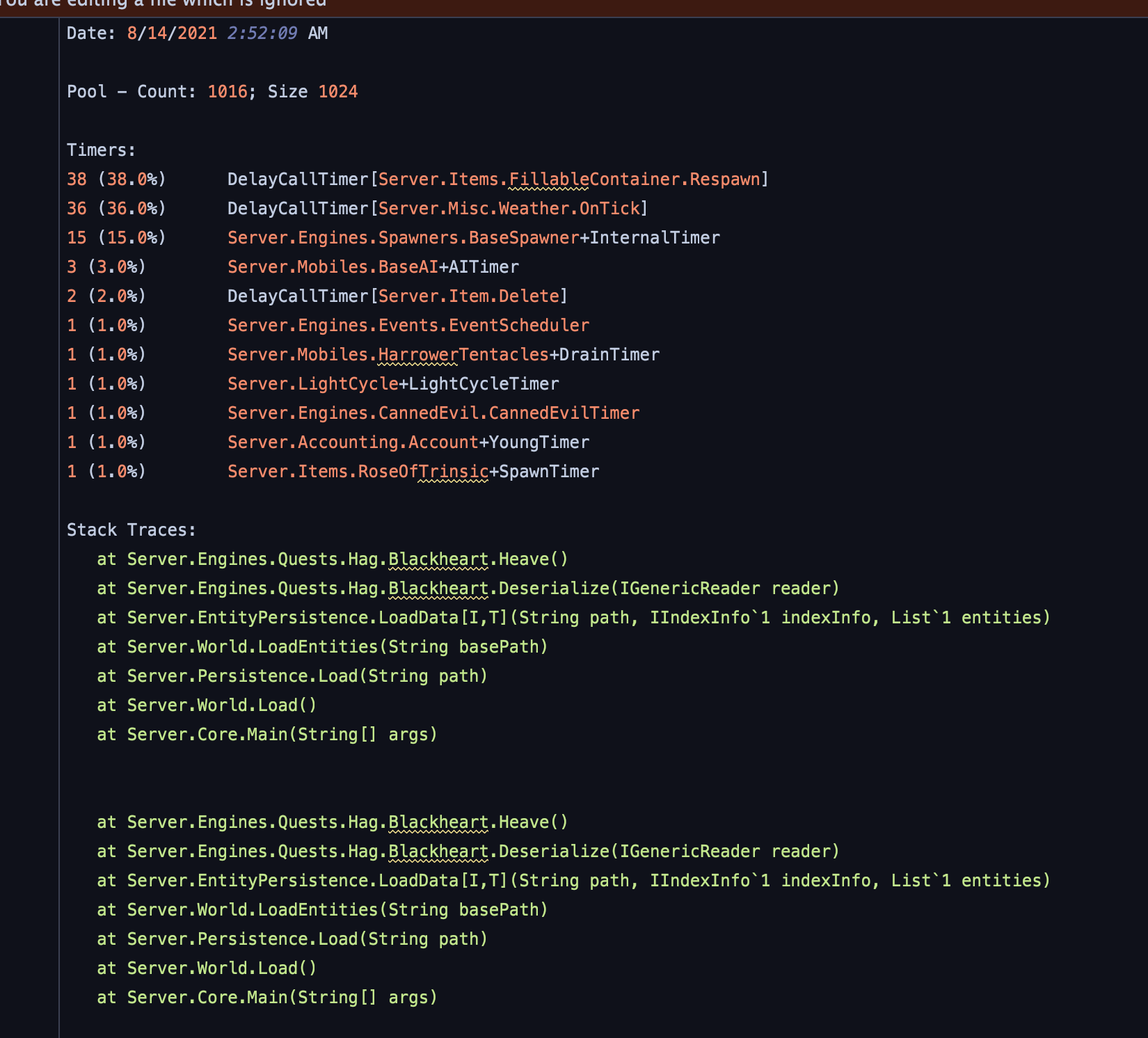
* Fixes `[dumptimers` command so it outputs properly, adds spacing, and stacktraces
* Adds `[Tidy]` for serializing Lists. This will remove deleted entities during world save before serializing the list.
* Adds helpers for managing Lists/Sets/Dictionaries


### New API

```cs
// Creates the list if it is null, then adds
Utility.Add(ref list, value);
Utility.Add(ref set, value);
Utility.Add(ref dict, key, value);

// Nulls the variable if the count is zero
Utility.Remove(ref list, value);
Utility.Remove(ref set, value);
Utility.Remove(ref dict, key);

// Marks entity as dirty in addition to doing the action
entity.Add(list, value);
// Marks entity as dirty, and will create list if it doesn't exist
entity.Add(ref list, value);

// Marks entity as dirty in addition to doing the action
entity.Remove(list, value);
// Marks entity as dirty, and will null the list count is zero
entity.Remove(ref list, value);
```


### Updates to [dumptimers
<img width="825" alt="Screen Shot 2021-08-14 at 2 55 10 AM" src="https://user-images.githubusercontent.com/3953314/129442449-ccf7fe14-29d6-4f3f-9366-c8eb7b9828a7.png">
### Changes/Fixes:
* Adds timer pooling.
* Allows pool to be configurable in ModernUO.json
* Pool replenishes itself asynchronously if depleted.
* Fixes an issue with barkeeps and town criers
* Fixes an issue with incognito buff icons not being removed
* Fixes an issue with polymorph name mod not being removed
* Fixes several places where timers go on forever even after an object is deleted, keeping a reference (memory leak)
* Eliminates the timer for MiningCart altogether.
* Deletes `AcidSlime` since it is a duplicate of `PoolOfAcid`
* Fixes HonorableExecution and standardizes the code for other Bushido moves.

## Changes to the Timer API:
```cs
public class Timer
{
  // Creates a timer that will be returned to the pool once execution stops.
  public static void StartTimer(Action callback);
  public static void StartTimer(TimeSpan delay, Action callback);
  public static void StartTimer(TimeSpan delay, TimeSpan interval, Action callback);
  public static void StartTimer(TimeSpan interval, int count, Action callback);
  public static void StartTimer(TimeSpan delay, TimeSpan interval, int count, Action callback);

  // Creates a timer and returns a token for more control. Requires manual cancellation in order for the timer to be returned to the pool.
  // If the token is dereferenced, the timer will be dereferenced too. While not returning a timer to the pool is not considered hazardous, it does defeat the purpose of pooled timers.
  public static void StartTimer(Action callback, out TimerExecutionToken token);
  public static void StartTimer(TimeSpan delay, Action callback, out TimerExecutionToken token);
  public static void StartTimer(TimeSpan delay, TimeSpan interval, Action callback, out TimerExecutionToken token);
  public static void StartTimer(TimeSpan interval, int count, Action callback, out TimerExecutionToken token);
  public static void StartTimer(TimeSpan delay, TimeSpan interval, int count, Action callback, out TimerExecutionToken token);

  // If you aren't sure how to use the API above, or you don't care about performance, then you can use the old RunUO Timer.DelayCall
  public static DelayCallTimer DelayCall(Action callback);
  public static DelayCallTimer DelayCall(TimeSpan delay, Action callback);
  public static DelayCallTimer DelayCall(TimeSpan delay, TimeSpan interval, Action callback);
  public static DelayCallTimer DelayCall(TimeSpan interval, int count, Action callback);
  public static DelayCallTimer DelayCall(TimeSpan delay, TimeSpan interval, int count, Action callback);
}

public struct TimerExecutionToken
{
  public bool Running { get; }
  public int Index { get; }
  public int RemainingCount { get; }
  public DateTime Next { get; }
}
```

## When to use `TimerExecutionToken`?
Use tokens when you want to gain the performance benefit of using a pooled timer, but you need one of the following:
* Access to the next time the timer will tick:`token.Next`
* Access to which interval, how many intervals there are, or how many are remaining: `token.Index`, `token.Count`, and `token.RemainingCount`
* Stop a timer manually.
* Determine if the timer is running: `timer.Running`
* See notes below about requirements for using tokens!

## Notes about using the TimerExecutionToken:
When you opt-in to receive a token, you must call `Cancel()` to return the timer. This can be done inside of the callback, or outside of the callback at any time.
If this is not called and your timer is an infinite interval, then you will create a potential memory leak, or null pointer exception in your callback.
If the timer ends and is stopped, but cancel is not called, then the timer will never return to the pool and stay referenced until the token is deleted or cancel is called. (Memory leak)

## Is this thread safe?
No. The ModernUO timer system is not thread safe at all. If you require a thread safe timer system, contact me and I'll help adapt this system. Keep in mind that there is a massive performance hit to make this thread safe when there are literally no use cases for it.

If you need to synchronize execution, meaning you want to execute code from another thread on the core thread. Let's say you have a discord bot that is pushing commands to the game server. Then use `EventLoopContext.Post(SendOrPostCallback callback, object state);`.
- [X] Fixes bad `ReadEnum` by size
- [X] Fixes array, list, and set not handling null values properly.
  - It will be up to the user (for now) to null out empty lists using `[AfterDeserialization]`. Convenience may be added later.
- [X] Fixes errors with `dotnet clean` and non-empty generation folder
- [X] Fixes bad field indexes on `Account.cs` causing `tags` to not be serialized/deserialized.
  - This was caused by a duplicate entry. Don't have protection against this _yet_.
- [X] Fixes TimeSpan not working with codegen
- [X] Fixes bad check for generic classes with a serialize method and deserialize ctor
- [X] Moves Accounts to codegen so it is versioned
- [X] Fixes deserialization of old Accounts with no version variable.
- [X] Fixes deserialize seek not doing anything. 🙈
- [X] Adds Email to serialization
- Adds `[ManualDirtyChecking]` for anyone that adds it themselves.
- Adds detection of `[Serializable]` and `[ManualDirtyChecking]` at startup to help identify scripts that need migration.
### Additions
- Automatically opts-out `Item/Mobile/Guild/Accounts` from dirty checking with a new property `UseDirtyChecking`
- Codegen now enables `UseDirtyChecking` via getter. This requires that the property is `virtual` for derived types.

### Fixes
- Fixes `EncodedInt` being broken
- Fixes issues with new custom serializable types that are not derived from Item/Mobile/etc.
- Removes double dirty checking.

### Example of a brand new serializable type that isn't an Item/Mobile/etc.
User created code:
```cs
using System;

namespace Server.Items
{
    [Serializable(0)]
    public partial class NewTestEntityObject : ISerializable
    {
        [EncodedInt]
        [SerializableField(0)]
        private int _someProperty;

        public NewTestEntityObject()
        {
            SetTypeRef(GetType());
            // Add to serial tracking like World.Item
            /*
            Serial = World.NewEntity;
            World.AddEntity(this);
            */
        }

        [AfterDeserialization]
        private void AfterDeserialization()
        {
            Console.WriteLine("This ran!");
        }

        public int TypeRef { get; }
        public Serial Serial { get; }
        public void Delete()
        {
        }

        public bool Deleted { get; set; }
        public void SetTypeRef(Type type)
        {
            // Type tracking for persistence goes here
            /*
            TypeRef = World.NewEntityTypes.IndexOf(type);
            if (TypeRef == -1)
            {
                World.NewEntityTypes.Add(type);
                TypeRef = World.NewEntityTypes.Count - 1;
            }
            */
        }
    }
}
```

Generated code:
```cs
namespace Server.Items
{
    public partial class NewTestEntityObject
    {
#pragma warning disable 0414
        private const int _version = 0;
#pragma warning restore 0414

        public int SomeProperty
        {
            get => _someProperty;
            set
            {
                if (value != _someProperty)
                {
                    _someProperty = value;
                    ((ISerializable)this).MarkDirty();
                }
            }
        }

        long ISerializable.SavePosition { get; set; } = -1;
        BufferWriter ISerializable.SaveBuffer { get; set; }
        bool ISerializable.UseDirtyChecking => true;

        public NewTestEntityObject(Serial serial)
        {
            Serial = serial;
            SetTypeRef(typeof(NewTestEntityObject));
        }

        public void Serialize(IGenericWriter writer)
        {

            writer.WriteEncodedInt(_version);

            writer.WriteEncodedInt(SomeProperty);
        }

        public void Deserialize(IGenericReader reader)
        {
            var version = reader.ReadEncodedInt();

            SomeProperty = reader.ReadEncodedInt();

            Timer.DelayCall(AfterDeserialization);
        }
    }
}
```
### Features
* Fully abstracts serialization by using compile-time attributes.
* Supports serializing the following:
  - Primitives (integers, strings, etc)
  - IP Addresses
  - BigDecimal
  - DateTime, Delta DateTimes
  - TimeSpan
  - Server.Race
  - Server.Map
  - Point2D, Point3D, Rect2D, Rect3D
  - Existing/New `ISerializable` references
  - Lists/Sets of serializable types
  - Type with a `Serialize` method and constructor that takes an `IGenericReader`
* Supports forward-only migration
* Supports existing RunUO deserialization for older versions by changing to the following signature:
  - `public void OldDeserialize(IGenericReader reader, int version)`
  - Must remove deserializing the version since this is already done
* Supports serializing from private fields or custom made properties.
* Types do not require inheriting Item/Mobile. Code gen will fully create `ISerializable` information.
  - This is not recommended yet, since it requires wiring to `Persistence` which will cause lots of unresolved symbol errors until code gen is built.

### Example
```cs
using System.Collections.Generic;

namespace Server.Items
{
    [Serializable(1)]
    public partial class TestItem1 : Item
    {
        [SerializableField(1)]
        [SerializableFieldAttr("[CommandProperty(AccessLevel.Administrator)]")]
        private List<Item> _someProperty;

        private void Deserialize(IGenericReader reader, int version)
        {
        }
    }
}
```

Generates this:
```cs
namespace Server.Items
{
    public partial class TestItem1
    {
#pragma warning disable 0414
        private const int _version = 1;
#pragma warning restore 0414

        [CommandProperty(AccessLevel.Administrator)]
        public System.Collections.Generic.List<Server.Item> SomeProperty
        {
            get => _someProperty;
            set
            {
                if (value != _someProperty)
                {
                    ((ISerializable)this).MarkDirty();
                    _someProperty = value;
                }
            }
        }

        public TestItem1(Serial serial) : base(serial)
        {
        }

        public override void Serialize(IGenericWriter writer)
        {
            var savePosition = ((Server.ISerializable)this).SavePosition;
            if (savePosition > -1)
            {
                writer.Seek(savePosition, System.IO.SeekOrigin.Begin);
                return;
            }
            writer.WriteEncodedInt(_version);
            writer.Write(_someProperty);
        }

        public override void Deserialize(IGenericReader reader)
        {
            var version = reader.ReadEncodedInt();
            if (version < 1)
            {
                OldDeserialize(reader, version);
                ((Server.ISerializable)this).MarkDirty();
                return;
            }
            SomeProperty = reader.ReadEntityList<Server.Item>();
        }
    }
}
```

And this:
```json
{
  "version": 1,
  "type": "TestItem1",
  "properties": [
    {
      "name": "SomeProperty",
      "type": "System.Collections.Generic.List\u003CServer.Item\u003E",
      "rule": "ListMigrationRule",
      "ruleArguments": [
        "Server.Item",
        "SerializableInterfaceMigrationRule"
      ]
    }
  ]
}
```
- [X] Caches DateTime.NowUtc on the game loop (not other threads)
- [X] Replaces all locations where it makes sense
- [X] Adds Min/Max for `IComparable` (TimeSpan, DateTimes, etc)
Closes#261
- [X] Adds `Respawn` command
- [X] Adds `EditSpawner` command
- Usage: `[global editspawner <type> <arguments> set <properties>`
- This command replaces the arguments (optional) and properties of the affected spawners for that type
- [X] Adds `SpawnProps` command
- Usage: `[area spawnprops`
- This command brings up a gump to modify targeted spawners based on the targeted entity.
- To do this, the props/values are copied and then used to construct a properties list for the spawner entry.
Closes#531
- [X] Removes network pause/resume
- [X] Adds back packet profiler
- [X] Adds state machine to keep track and trace netstates
- [X] Changes NetState.Running back to using an interlock exchange
- [X] Adds preliminary packet throttling support


### Packet Throttling
- `[GetThrottle <packetId>` to get the delay in milliseconds for that packet
- `[SetThrottle <packetId> <delay>` to set the delay in milliseconds for that packet
The settings are saved to `Configuration/throttles.json`
- [X] Fixes some issues with the type caching
- [X] Changes type check default to ignore case
- [X] Splits out type caching of insensitive and sensitive lists. This means less stuff to iterate through when checking a type against the string.
- [X] Adds an ArrayEnumerator, mostly for reference purposes (copy/paste as needed)
- [X] Removes some uses of linq
- [X] Creates struct based enumerator for Skills
- [X] Creates a struct based enumerator for TypeCache
- [X] Changes HarvestDefinition to an init array instead of List
- [X] Changes HeritageTokenGump Response from List to Array
- [X] Removes some string allocations (e.g. split)
- [X] Optimizes some collections
- [X] Converts insensitive to extension methods of built-ins.
- [X] Adds ordinal (case sensitive) string helpers
- [X] Fixes conditionals for in-game commands so they use Ordinal comparisons.
- [X] Replaces ToLower.Contains with InsensitiveContains
- [X] Adds ValueStringBuilder
- [X] Implements ValueStringBuilder in a few places where it makes sense
- [X] Removes the redundant Wrap function and replaces it with an optimized version
- [X] Fixes list conversions in Utility
Closes#351
Bumps release version
## Breaking Change
* IP Matching no longer supports `?` (e.g. you cannot do: "192.16?.0.1")
* IP Matching no longer supports `*` and other values in the same section (e.g. you cannot do "192.1\*.0.1")
  * To do "192.1\*.0.1", you should use the range option with three separate entries: "192.100-199.0.1", "192.1.0.1", "192.10-19.0.1"

## Non-Breaking Changes
- [X] Adds IPv6 support (not for servers though, just clients)
- [X] Adds interning support for IPv4 mapped to IPv6
- [X] Updates IPv4ToAddress (don't use this unless you know it is IPv4 or IPv4 mapped to IPv6)

## Note:
UO Does not support IPv6 for the server. To support an IPv6 server IP you will need to use CUO or some kind of custom client and probably modify it accordingly.

Bumps release version
- [X] Fixes several bugs
- [X] Updates more ordinal issues
- [X] Cleans up the code a bit
- [X] Turns classes static that should have been
- [X] Changes TcpServer.Instances to a HashSet

Bumps release version
- [X] Removes all save strategies
- [X] Removes duplicate file writer that won't be used
- [X] Removes persistence (it will become a duplicate system)
- [X] Add a save position variable to skip serializing a clean item/mobile
- [X] Update Guilds/Accounts to be IEntity types
    - Because guilds are abstract, this may make serialization tricky.
- [X] Update the generalized IEntity writing
- [X] Update the load/save to write to buffers then to files in background


Bumps release version
- [X] Moved packets from objects to functions
- [X] Fixed bug where characters were showing up with their modded names in the character list

Bumps release version
- [X] Removing Kestrel & Libuv
- [X] Cleaning up NetState
- [X] Removing System.IO.Pipelines
- [X] Cleaning up packet reading
- [X] Adds a maximum of 5000 sockets (configurable) to prevent OOM
- [X] Replaces the AsyncState with a thread-safe wrapped boolean called NetworkState
- [X] Removes Parallel.ForEach (no perf gain)
- [X] Removes custom houses compression on another thread
- [X] Test high load scenarios

Bumps release version