* Adds save flag support (see `ElvenGlasses` for an example)
* Updates AOSAttributes so they are code genned
* Fixes embedded object support by adding an `IRawSerializable`
* Fixes various inconsistencies in serializing with codegen
### THIS IS A BREAKING CHANGE IF YOU ARE ALREADY USING CODEGEN. IF YOUR WORLD HAS ERRORS LOADING PLEASE CONTACT ME ON DISCORD. ORE MIGHT FAIL TO LOAD.

### Changes
* Fixes Components from addons not marking dirty
* Code gens BaseAddonContainer
* Code gens Ingots
* Fixes code gen deserialization for Ore
* Code gens dyetubs
* Code gens reagents
* Code gens tailor commodities
* Code gens fish
### Changes/Fixes:
* Adds timer pooling.
* Allows pool to be configurable in ModernUO.json
* Pool replenishes itself asynchronously if depleted.
* Fixes an issue with barkeeps and town criers
* Fixes an issue with incognito buff icons not being removed
* Fixes an issue with polymorph name mod not being removed
* Fixes several places where timers go on forever even after an object is deleted, keeping a reference (memory leak)
* Eliminates the timer for MiningCart altogether.
* Deletes `AcidSlime` since it is a duplicate of `PoolOfAcid`
* Fixes HonorableExecution and standardizes the code for other Bushido moves.

## Changes to the Timer API:
```cs
public class Timer
{
  // Creates a timer that will be returned to the pool once execution stops.
  public static void StartTimer(Action callback);
  public static void StartTimer(TimeSpan delay, Action callback);
  public static void StartTimer(TimeSpan delay, TimeSpan interval, Action callback);
  public static void StartTimer(TimeSpan interval, int count, Action callback);
  public static void StartTimer(TimeSpan delay, TimeSpan interval, int count, Action callback);

  // Creates a timer and returns a token for more control. Requires manual cancellation in order for the timer to be returned to the pool.
  // If the token is dereferenced, the timer will be dereferenced too. While not returning a timer to the pool is not considered hazardous, it does defeat the purpose of pooled timers.
  public static void StartTimer(Action callback, out TimerExecutionToken token);
  public static void StartTimer(TimeSpan delay, Action callback, out TimerExecutionToken token);
  public static void StartTimer(TimeSpan delay, TimeSpan interval, Action callback, out TimerExecutionToken token);
  public static void StartTimer(TimeSpan interval, int count, Action callback, out TimerExecutionToken token);
  public static void StartTimer(TimeSpan delay, TimeSpan interval, int count, Action callback, out TimerExecutionToken token);

  // If you aren't sure how to use the API above, or you don't care about performance, then you can use the old RunUO Timer.DelayCall
  public static DelayCallTimer DelayCall(Action callback);
  public static DelayCallTimer DelayCall(TimeSpan delay, Action callback);
  public static DelayCallTimer DelayCall(TimeSpan delay, TimeSpan interval, Action callback);
  public static DelayCallTimer DelayCall(TimeSpan interval, int count, Action callback);
  public static DelayCallTimer DelayCall(TimeSpan delay, TimeSpan interval, int count, Action callback);
}

public struct TimerExecutionToken
{
  public bool Running { get; }
  public int Index { get; }
  public int RemainingCount { get; }
  public DateTime Next { get; }
}
```

## When to use `TimerExecutionToken`?
Use tokens when you want to gain the performance benefit of using a pooled timer, but you need one of the following:
* Access to the next time the timer will tick:`token.Next`
* Access to which interval, how many intervals there are, or how many are remaining: `token.Index`, `token.Count`, and `token.RemainingCount`
* Stop a timer manually.
* Determine if the timer is running: `timer.Running`
* See notes below about requirements for using tokens!

## Notes about using the TimerExecutionToken:
When you opt-in to receive a token, you must call `Cancel()` to return the timer. This can be done inside of the callback, or outside of the callback at any time.
If this is not called and your timer is an infinite interval, then you will create a potential memory leak, or null pointer exception in your callback.
If the timer ends and is stopped, but cancel is not called, then the timer will never return to the pool and stay referenced until the token is deleted or cancel is called. (Memory leak)

## Is this thread safe?
No. The ModernUO timer system is not thread safe at all. If you require a thread safe timer system, contact me and I'll help adapt this system. Keep in mind that there is a massive performance hit to make this thread safe when there are literally no use cases for it.

If you need to synchronize execution, meaning you want to execute code from another thread on the core thread. Let's say you have a discord bot that is pushing commands to the game server. Then use `EventLoopContext.Post(SendOrPostCallback callback, object state);`.
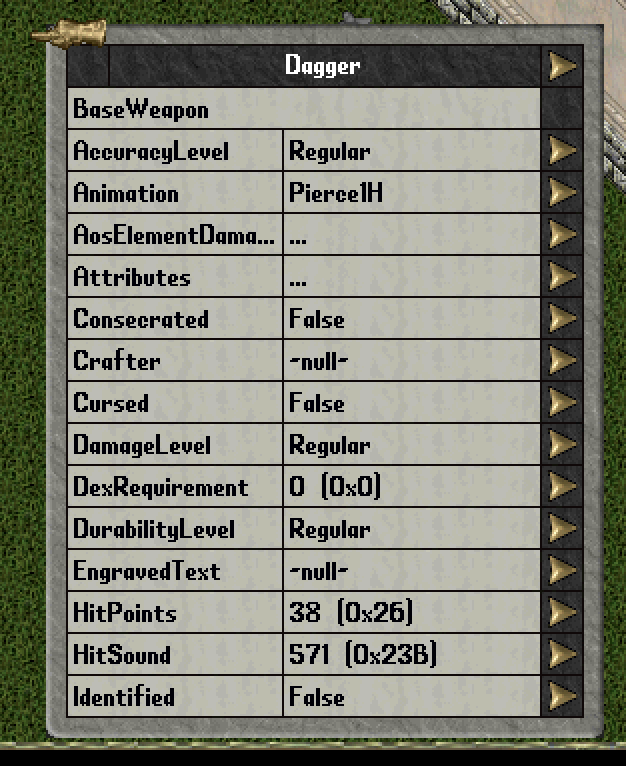
- [X] Adds a property to `CommandProperty` to allow modifying `PropertyObject` where there is no property setter that is accessible.
- [X] Updates AosAttributes and friends

Example of how to make this work:
```cs
        [CommandProperty(AccessLevel.GameMaster, canModify: true)]
        public AosWeaponAttributes WeaponAttributes { get; private set; }
```

This fix is necessary because in release mode the optimizer will sometimes _entirely remove the setter_ because it knows it can do something that is more efficient _when the property setter is private_. RunUO got around this by declaring a public setter explicitly that _was empty_.

### Screenshot
<img width="313" alt="Screen Shot 2021-05-15 at 11 34 01 PM" src="https://user-images.githubusercontent.com/3953314/118387955-49293c00-b5d6-11eb-8f31-a3b5e31bd18b.png">
- [X] Caches DateTime.NowUtc on the game loop (not other threads)
- [X] Replaces all locations where it makes sense
- [X] Adds Min/Max for `IComparable` (TimeSpan, DateTimes, etc)
Closes#261
- [X] Removes network pause/resume
- [X] Adds back packet profiler
- [X] Adds state machine to keep track and trace netstates
- [X] Changes NetState.Running back to using an interlock exchange
- [X] Adds preliminary packet throttling support


### Packet Throttling
- `[GetThrottle <packetId>` to get the delay in milliseconds for that packet
- `[SetThrottle <packetId> <delay>` to set the delay in milliseconds for that packet
The settings are saved to `Configuration/throttles.json`
SpanWriter now has an argument that allows it to be resizable.
```cs
public SpanWriter(Span<byte> initialBuffer, bool resize = false)
public SpanWriter(int initialCapacity, bool resize = false)
```

If a SpanWriter is set to be resizable, or given an initial capacity instead of a buffer, it must be disposed:
```cs
public static void SomeMethod()
{
    using var writer = new SpanWriter(stackalloc byte[512], true);
    // stuff

    // Automatic Dispose of writer
}
```

This is because the SpanWriter uses `ArrayPool<byte>.Shared` _rented buffers_ to resize. If the writer is not disposed, those buffers will never be reused resulting in a _memory leak_.

It is possible that the SpanWriter will outright ditch the initial buffer if resize is set to true and growing is needed. To check/account for that we can do the following:

```cs
public static void SomeMethod()
{
    Span<byte> span = stackalloc byte[512];
    using var writer = new SpanWriter(span, true);
    // write some stuff that causes the span to grow

    span = writer.RawBuffer;
    // Do stuff with the span
}
```

Make sure you don't accidentally `Dispose()` the writer or use the `RawBuffer` outside of the `using` block. If you do, bad things will happen! (NullPointerException, or a fresh SpanWriter with no buffer, depending on the situation).

SpanWriter can also now be used with a fixed statement since it has a `PinnableReference()` function.
- [X] Fixes an issue where a buffer smaller than 8 bytes would not double with enough space in some cases.
- [X] Fixes an issue with dupe copying the savebuffer reference (ugh).
- [X] Streamlines the IGenericWriter API to use better generics.
- [X] Streamlines the IGenericReader API to use better generics.
- [X] Forces `tidying` of a List/HashSet to be done externally since Writers/Readers should not have side effects.
- [X] Fixes an issue where Tidying a list didn't TrimExcess, causing memory leaks.
- [X] Reverted the meaning of `World.Running` to specifically refer to any world state post world loading.
  - NOTE: Do not use this if you want to block on world saves. Instead use checks against `WorldState.Saving` states.
- [X] Fixes an issue with serializing negative DateTime deltas.
- [X] Fixes a potential issue with serializing non-UTC DateTime.

Bumps release version
- [X] Updates Movement packets
- [X] Adds OSI fastwalk packets. These aren't used on OSi anymore.
- [X] Adds new movement handling, but looks like the client doesn't use it. (Also leaving the 0x4000 Character List Flag off)
- [X] Adds time sync request handler, but also looks like the client doesn't use it.
- [X] Adds time sync response for time sync, just in case, but it isn't used, so not sure about the arguments.
- [X] Reimplements RunUO's fastwalk to use a circular array on the netstate instead of every mobile
- [X] Removes ClearFastwalkStack from RunUO implementation. This shouldn't be needed anymore

Changed fastwalk settings:
```cs
        public static int WalkFootDelay { get; set; } = 440;
        public static int RunFootDelay { get; set; } = 220;
        public static int WalkMountDelay { get; set; } = 220;
        public static int RunMountDelay { get; set; } = 110;

        public static bool EnableFastwalkPrevention { get; set; } = true;
        public static AccessLevel FastwalkExemptionLevel { get; set; } = AccessLevel.Counselor;

        // If this is changed during runtime, then the steps array needs resizing.
        public static int MaxSteps { get; private set; } = 4;
```

modernuo.json
```json
{
  "settings": {
    "movement.delay.runFoot": "220",
    "movement.delay.runMount": "110",
    "movement.delay.walkFoot": "440",
    "movement.delay.walkMount": "220",
    "movement.enableFastWalkPrevention": "True",
    "movement.fastwalkExemptionLevel": "Counselor",
    "movement.maxSteps": "4"
  }
}
```

Notes about OSI fastwalk:
While it does work, I can't find a benefit in using it because of the variable speeds. If players moved at a single speed then we could refill the stack every X milliseconds with 6 keys and use a naive token bucket implementation.
Unfortunately variable speeds mount/run/walk/etc means we would have to use a leaky bucket algorithm.
If we are using a leaky bucket algorithm with a variable leak, then we don't need to send tokens because we are already tracking it on the server side.

ModernUO vs OSI Fastwalk:
When the fastwalk was implemented on OSI, it used up to 6 tokens. These tokens were probably distributed every 600-750 milliseconds. To get the same effect, the new fastwalk settings might need to be adjusted. I would tweak them and feel free to let me know what worked for you!

Bumps release version
### API Breaking Change
Combined `AsciiMessage` and `UnicodeMessage` into a single function that takes two arguments, `bool ascii` and `string lang`. Lang can be null (or anything) if ascii is true.

- [X] Changes message packets
- [X] Cleans up some code
- [X] Uses benchmarks to determine if the spanwriter + copyfrom
### Change to how DisplayEquipInfo works
* Fixes a bug where raw name wasn't used
* Fixes another bug where an empty, blank, or null string was still sending an empty crafted by property.

Bumps release version
- [X] Fixes several bugs
- [X] Updates more ordinal issues
- [X] Cleans up the code a bit
- [X] Turns classes static that should have been
- [X] Changes TcpServer.Instances to a HashSet

Bumps release version
- [X] Changes effect packets
- [X] Updates playing sounds
- [X] Updates Effects class to have more options so there are less direct calls to building the packets
- [X] Changes bonding status packet