## Problem

`RunEventLoop` span through its body regardless of whether there was anything to do — ~10% of a desktop core for an empty shard, and ~70% of a core on a 3 vCPU VPS. A process that never idles is exactly what burstable vCPU plans throttle, which is how this surfaced: lag spikes that went away when the operator bought more cores. The spin also denied the GC its natural pause points, so memory climbed until a world save forced a collection — alarming in task manager, harmless in practice, and a recurring source of "is my server leaking?" reports.

## Result

Windows desktop, real world of **190,728 items / 33,158 mobiles**, no players, saves and prebake off, three consecutive runs:

| | Legacy spin | Idle sleeping |
|---|---|---|
| **CPU** | 10.42 – 10.50% of one core | **0.78 – 1.00%** |
| **Tick lag** (peak/15s) | 4–10 ms | 5–11 ms |

**~10× less CPU with tick lag unchanged** — the CPU came free rather than being traded for latency. Slower hosts gain proportionally more. Spin mode (`server.eventLoopIdleWaitMs=0`) independently gained **7× the iterations per core** (1.19M → 8.3M cycles/sec) from the ring's AcceptEx rework.

## How

The loop blocks in `NetState.WaitForCompletion` whenever every queue it drains is empty (all the drains are bounded, so leftovers keep it awake). Receive completions, new connections, and cross-thread `LoopContext.Post` (via the ring's sticky `Wake()`) are all in the wait set, so sleeping adds no latency to any of them. Only timer-driven logic sees wheel lag, bounded by the idle wait.

**Health is measured at the only place sleeping can cause harm.** A sleep is bounded by the time to the next wheel turn, so a correctly honoured sleep can never miss a deadline — the only failure mode is the host returning the wait late. That overshoot is measured on every sleep (one extra timestamp read; production's entire accounting cost), and an escalating backoff suspends sleeping when it persists. By construction, server work — saves, heavy staff commands, deep timer callbacks — cannot trip it, so the warning means exactly one thing: *the host is not scheduling the process promptly*, with two known remedies (dedicated CPU, or `=0`). Hosts with no high-resolution wait mechanism at all are detected once at startup and spin instead.

**CPS is removed.** `Core.CyclesPerSecond`/`AverageCPS` measured nothing actionable before and became actively misleading once the loop sleeps (the rate is set by the sleep, not by shard health). The admin gump's Performance page now shows the verdict instead: `Healthy` / `Sleep suspended (host)` / `Spinning (configured)`.

## Configuration

| Setting | Default | Meaning |
|---|---|---|
| `server.eventLoopIdleWaitMs` | `2` | Longest idle block. Measured across 1/2/4/8 ms, 2 is where the trade stops being free. `0` = never sleep: ~98% of a core, zero scheduling overhead — for large shards on dedicated CPU. |
| `server.lateWakeThreshold` | `1` | Idle waits the host may return a full tick late, per second, before sleeping backs off. Raise for jittery hosts; very high disables the backoff. |

## Diagnostics (compiled out by default)

`dotnet build -p:EventLoopProfiling=true` compiles in `EventLoopProfiler` — every hook is `[Conditional("EVENT_LOOP_PROFILING")]`, so normal builds contain zero profiling IL. The profiling build decomposes each second of wall time into **work (per loop phase) / sleep / GC pause / stolen residual**, keeps ~15 minutes of history in a ring buffer, and the `[LoopStats` command prints the last minute and dumps the full history to CSV. `dev-docs/debugging-event-loop.md` is the diagnosis guide (for humans and AI): what production already tells you, when to flip the profiling build, the signature table for host-steal vs deep-processing vs GC vs wake bugs, why dotnet-trace comes last, and the GC/RAM "leak" misconception.

## Verification

- 815 Server.Tests green; both build configurations compile.
- Docker echo harness green on epoll and io_uring (ping-pong mode); kqueue verified manually on an M1 Max.
- A/B measurements and per-change numbers: `measure/event-loop` branch.

## Notes

The full measurement harness and vendored ring sources used to develop this live on the [`measure/event-loop`](https://github.com/modernuo/ModernUO/tree/measure/event-loop) branch, kept for future loop work.
## Summary
- **Timer-aware idle sleep**: Exposes `Timer.MillisecondsUntilNextTick()` to calculate remaining ms until the next timer wheel tick (0–8ms). The game loop sleeps for that duration minus a 1ms safety margin, instead of spinning at 100% CPU.
- **I/O completion wakeup**: Replaces `Thread.Sleep` with `NetState.WaitForCompletion()`, which uses platform-native completion notification (RIO `RIONotify` on Windows, `eventfd` on Linux, `kevent` timeout on macOS) to wake immediately when network data arrives during sleep.
- **Always-on**: Removes the debug-only `core.enableIdleCPU` config gate. The sleep is self-regulating — under load, `MillisecondsUntilNextTick` returns 0 so no sleep occurs (zero overhead). On idle, CPU drops from ~100% to ~1%.
- **CPS calculation cleanup**: Replaces the 128-element ring buffer with an EMA (exponential moving average) for `CyclesPerSecond`/`AverageCPS` — fewer allocations, no LINQ `.Average()` call each sample.
- **IORingGroup 1.0.6**: Adds `WaitForCompletion(int timeoutMs)` to the `IIORingGroup` interface with platform implementations:
  - **Windows**: `RIONotify` arms the CQ event, `WaitForSingleObject` with timeout
  - **Linux**: `eventfd` registered with io_uring, `poll()` with timeout
  - **macOS**: `kevent()` with timeout

## Test plan
- [ ] Build succeeds on all platforms (`dotnet build`)
- [ ] Empty server: verify CPU usage drops from ~100% to ~1% idle
- [ ] Loaded server: verify no added latency — `MillisecondsUntilNextTick` returns 0 when timers are firing, sleep is skipped
- [ ] Connect a client during idle — verify connection accepted within one timer tick (~8ms)
- [ ] Verify `[admin` gump shows reasonable CPS values (EMA convergence)
### Summary

Fixes a few minor issues with timers:
- Timer.Delay and Timer.Interval was not reflecting the actual tick time (aligned to the next 8ms)
- Negative delay values were causing a crash when DateTime.Now - delay was below DateTime.MinValue
- Timer.Next now reflects the correct wall clock tick time based on the adjusted Delay.
- Timer.Next is not assigned when the timer is started. This was important for timers that were created, but started later.
### Summary

- Fixes timer intervals not continuing
- Fixes `Timer.Index` being off by 1. Should start at 0 for the first OnTick
- Simplifies Gift of Renewal end check
- Fixes force of nature not applying at the proper time and simplifies the timer logic.
* Fixes an edge case where a check to see if a timer was being executed resulted in it not being properly detached on stop. Fixed this by changing how we determine what timer is currently being executed.
* Adds execution count to #DEBUG_TIMERS so shards can get notified (rudimentarily for now) about sequentially executing long chains of timers.

Unfortunately, for now, there is no good option when it comes to executing timers. If we execute let's say 500, and defer the rest, that makes all timers effectively 8ms off until it "catches up". Depending on the shard, that may never happen.
**Only one functional change**
* Fixes a bug in LogFactory where `Warning` is being logged as `Information`

Non-functional changes:
* Updates/Fixes copyright headers
* Removes namespace scopes for core files.

View with [whitespace off](https://github.com/modernuo/ModernUO/pull/1187/files?w=1).
* Makes EnsureDirectory properly work for relative and absolute paths
* Adds a `PathUtility.GetFullPath` which returns full paths for relative paths to `Core.BaseDirectory`. If the path is absolute, it will return as-is.
* Moves EnsureDirectory to `PathUtility`. So `ScriptsHandler.EnsureDirectory` and `AssemblyHandler.EnsureDirectory` are now `PathUtility.EnsureDirectory`
* Fixes crash guard so that it copies accounts properly.
* Changes world save and auto archive to use a random folder name inside of the temp folder.
## Adds Auto Archiving
Backups are archived once an hour, day, and month. Archives older than 60 days are pruned automatically.

_Note: Automatic pruning is off by default_

### Archive compression format
The following formats are supported:
* Zstd (The fastest with best compression ratio)
* GZip
* Zip
* None (Tar)

_Note: By default archives use [zstandard](http://facebook.github.io/zstd/) format.
The archive format can be changed in modernuo.json `autoArchive.compressionFormat`_

### Restoring world from archive
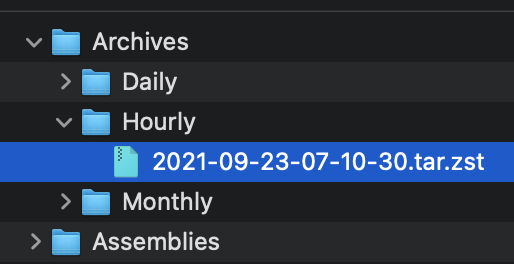
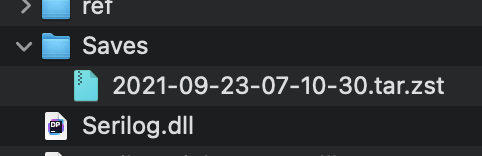
Move the archive to the Saves folder (tar.zst file). On startup the server will extract the file and restore the latest save. See pictures below.

### Manually extracting an archives
#### Windows
* Use the latest version of [7-zip w/ ZStandard](https://github.com/mcmilk/7-Zip-zstd/releases/latest)
  1. Extract the `.tar.zst` file.
  2. Extract the `.tar` file. (Yes you have to do it in two steps)
* On Windows 10 you can use the command line. `zstd.exe` is in the Assemblies folder after building ModernUO.
  1. `tar --use-compress-program "Distribution\Assemblies\zstd.exe -d" -xvf "Archives\Hourly\archivefile.tar.zst" -C "path to where you want to extract it"`
#### Mac
* Install [Keka](https://www.keka.io)
  1. Drop the .tar.zst onto the keka interface.
#### Linux
  1. Install zstd from a package manager
  2. Run `tar -I zstd -xvf "Archives\Hourly\archivefile.tar.zst" -C "path to where you want to extract it"`

### Other changes
* Changes Autosave to occur at the same time no matter when the server is booted.
* Adds `[SaveFrequency <delay> [warning]`command to set save frequency and warning frequency in-game.
* Adds support for time zones that are configurable. The system timezone can also be manually configured. Check `TimeZoneHandler.cs` for details.

<img width="257" alt="Screen Shot 2021-09-22 at 11 23 18 PM" src="https://user-images.githubusercontent.com/3953314/134464929-a5bf3cd8-2ef0-4476-a9ad-71d0816a19ac.png">
<img width="241" alt="Screen Shot 2021-09-22 at 11 23 39 PM" src="https://user-images.githubusercontent.com/3953314/134464945-5f6f96dc-3d1e-434d-8256-5c6b3705e786.png">
<img width="836" alt="Screen Shot 2021-09-22 at 11 34 39 PM" src="https://user-images.githubusercontent.com/3953314/134464957-625e57f2-ef47-4ca1-a0a7-cd40c9b6539c.png">
<img width="631" alt="Screen Shot 2021-09-22 at 11 34 50 PM" src="https://user-images.githubusercontent.com/3953314/134464969-b2d65c0d-f8f5-497a-a832-5d805e8e0b22.png">
1. Stopping a different timer, on the same slot as the timer being executed during OnTick
    * Adds a check for the timer wheel currently being executed and does not detach the timer on Stop().
1. Timers are added to the current slot if they need 4095 slots, before the chain is fully detached/executed
    * Removes all chains that will be executed from the timer wheel before executing.
* Fixed an issue where a timer truncated the link list.
* Fixed an issue where a timer stopped and started itself within an OnTick causing it to remove itself from the link list, but still think it's running.
* Fixes pooled timer leaking
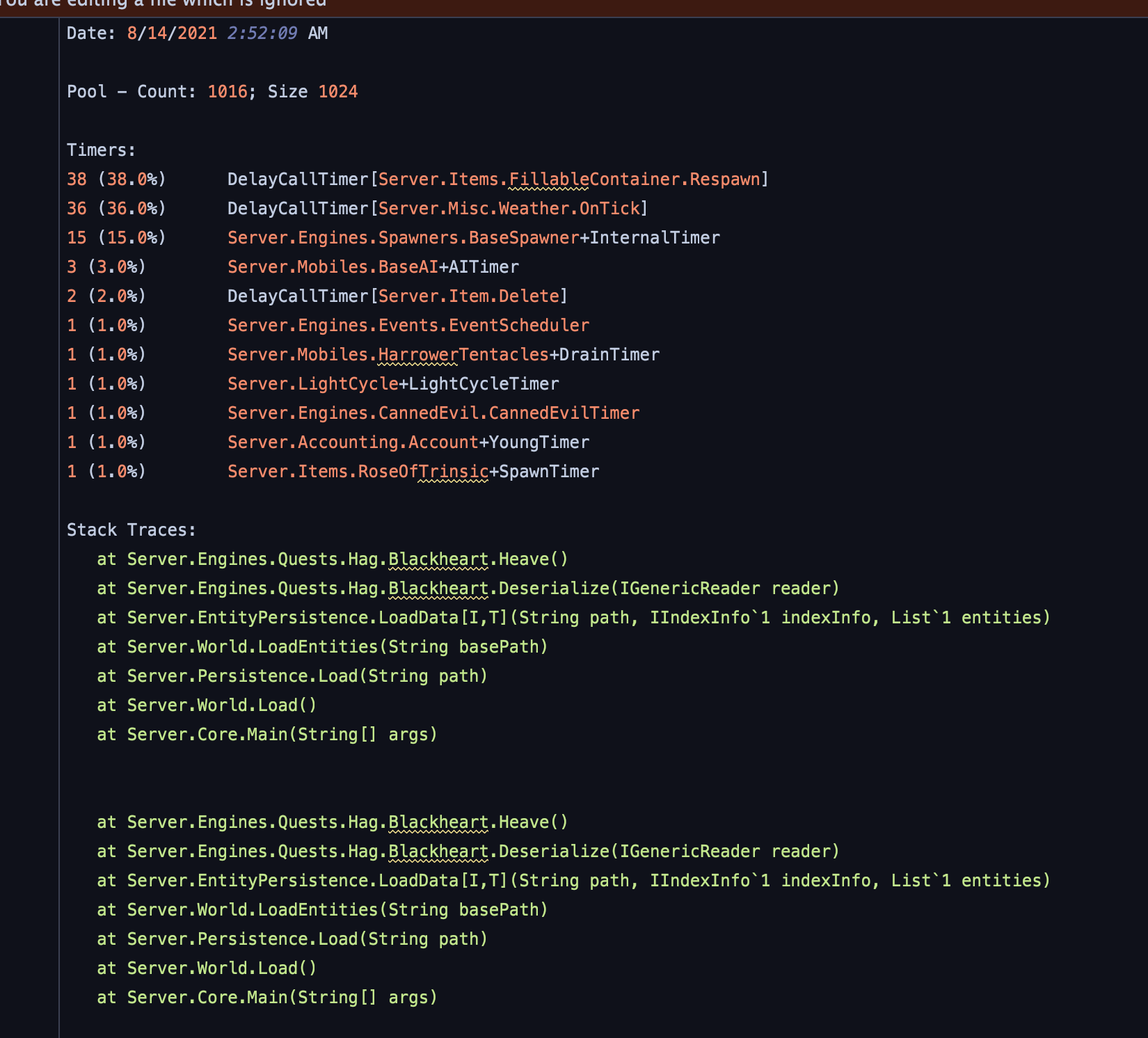
* Fixes `[dumptimers` command so it outputs properly, adds spacing, and stacktraces
* Adds `[Tidy]` for serializing Lists. This will remove deleted entities during world save before serializing the list.
* Adds helpers for managing Lists/Sets/Dictionaries


### New API

```cs
// Creates the list if it is null, then adds
Utility.Add(ref list, value);
Utility.Add(ref set, value);
Utility.Add(ref dict, key, value);

// Nulls the variable if the count is zero
Utility.Remove(ref list, value);
Utility.Remove(ref set, value);
Utility.Remove(ref dict, key);

// Marks entity as dirty in addition to doing the action
entity.Add(list, value);
// Marks entity as dirty, and will create list if it doesn't exist
entity.Add(ref list, value);

// Marks entity as dirty in addition to doing the action
entity.Remove(list, value);
// Marks entity as dirty, and will null the list count is zero
entity.Remove(ref list, value);
```


### Updates to [dumptimers
<img width="825" alt="Screen Shot 2021-08-14 at 2 55 10 AM" src="https://user-images.githubusercontent.com/3953314/129442449-ccf7fe14-29d6-4f3f-9366-c8eb7b9828a7.png">
### Changes/Fixes:
* Adds timer pooling.
* Allows pool to be configurable in ModernUO.json
* Pool replenishes itself asynchronously if depleted.
* Fixes an issue with barkeeps and town criers
* Fixes an issue with incognito buff icons not being removed
* Fixes an issue with polymorph name mod not being removed
* Fixes several places where timers go on forever even after an object is deleted, keeping a reference (memory leak)
* Eliminates the timer for MiningCart altogether.
* Deletes `AcidSlime` since it is a duplicate of `PoolOfAcid`
* Fixes HonorableExecution and standardizes the code for other Bushido moves.

## Changes to the Timer API:
```cs
public class Timer
{
  // Creates a timer that will be returned to the pool once execution stops.
  public static void StartTimer(Action callback);
  public static void StartTimer(TimeSpan delay, Action callback);
  public static void StartTimer(TimeSpan delay, TimeSpan interval, Action callback);
  public static void StartTimer(TimeSpan interval, int count, Action callback);
  public static void StartTimer(TimeSpan delay, TimeSpan interval, int count, Action callback);

  // Creates a timer and returns a token for more control. Requires manual cancellation in order for the timer to be returned to the pool.
  // If the token is dereferenced, the timer will be dereferenced too. While not returning a timer to the pool is not considered hazardous, it does defeat the purpose of pooled timers.
  public static void StartTimer(Action callback, out TimerExecutionToken token);
  public static void StartTimer(TimeSpan delay, Action callback, out TimerExecutionToken token);
  public static void StartTimer(TimeSpan delay, TimeSpan interval, Action callback, out TimerExecutionToken token);
  public static void StartTimer(TimeSpan interval, int count, Action callback, out TimerExecutionToken token);
  public static void StartTimer(TimeSpan delay, TimeSpan interval, int count, Action callback, out TimerExecutionToken token);

  // If you aren't sure how to use the API above, or you don't care about performance, then you can use the old RunUO Timer.DelayCall
  public static DelayCallTimer DelayCall(Action callback);
  public static DelayCallTimer DelayCall(TimeSpan delay, Action callback);
  public static DelayCallTimer DelayCall(TimeSpan delay, TimeSpan interval, Action callback);
  public static DelayCallTimer DelayCall(TimeSpan interval, int count, Action callback);
  public static DelayCallTimer DelayCall(TimeSpan delay, TimeSpan interval, int count, Action callback);
}

public struct TimerExecutionToken
{
  public bool Running { get; }
  public int Index { get; }
  public int RemainingCount { get; }
  public DateTime Next { get; }
}
```

## When to use `TimerExecutionToken`?
Use tokens when you want to gain the performance benefit of using a pooled timer, but you need one of the following:
* Access to the next time the timer will tick:`token.Next`
* Access to which interval, how many intervals there are, or how many are remaining: `token.Index`, `token.Count`, and `token.RemainingCount`
* Stop a timer manually.
* Determine if the timer is running: `timer.Running`
* See notes below about requirements for using tokens!

## Notes about using the TimerExecutionToken:
When you opt-in to receive a token, you must call `Cancel()` to return the timer. This can be done inside of the callback, or outside of the callback at any time.
If this is not called and your timer is an infinite interval, then you will create a potential memory leak, or null pointer exception in your callback.
If the timer ends and is stopped, but cancel is not called, then the timer will never return to the pool and stay referenced until the token is deleted or cancel is called. (Memory leak)

## Is this thread safe?
No. The ModernUO timer system is not thread safe at all. If you require a thread safe timer system, contact me and I'll help adapt this system. Keep in mind that there is a massive performance hit to make this thread safe when there are literally no use cases for it.

If you need to synchronize execution, meaning you want to execute code from another thread on the core thread. Let's say you have a discord bot that is pushing commands to the game server. Then use `EventLoopContext.Post(SendOrPostCallback callback, object state);`.
- [X] Cleans up gump packets
- [X] Adds event loop task synchronization
- [X] Moves timer pause and cleans up the delay task timer class
- [X] Cleans up the conserve cpu
- [X] Renames variables to make them consistent with the new style
- [X] Removes process delta recursion checking.
- [X] Properly diposes net states. This fixes edge cases that may cause hanging connections to stay open longer than they should.
- [X] Fixes an issue with gump items not compiling properly

Users can now utilize `Timer.Pause()` since the code will be executed on the proper thread.

```cs
public void async void Talk()
{
    _canTalk = false;
    await Timer.Pause(Utility.RandomMinMax(5000, 8000)); // Talk after 5-8 seconds
    DoTalk();
    await Timer.Pause(Utility.RandomMinMax(12000, 25000)); // Reset ability to talk after 12-25 seconds
    _canTalk = true;
}
```
- [X] Exposes Index/Count on the timer.
- [X] Cleans up abilities
- [X] Combines some spell context/info objects with their timers to reduce allocations
- [X] Fixes a bug where immolating weapon both finishes effect or stops in the wrong order due to a race condition.