## Why

An Argon2 verify is **~8.9 ms of frozen world per login attempt** — more than half a 16 ms frame. Failed attempts cost exactly the same as successful ones, by design, so a credential-stuffing flood is a full-cost stall per packet without needing valid credentials. `SetPassword` derives a hash too, so `[password`, the admin gump and account creation each pay the same.

## What the measurement says

Off-loading does not delete the cost, it relocates it. Three things stay on the loop:

| Component | Measured |
|---|---:|
| Inline verify (today) | **8.92 ms** |
| Dispatch to the worker | 210 ns |
| Drain the continuation off `LoopContext` | 13 ns |
| Loop's own work slowed by shared-L3 eviction | **0.05 – 5.44 ms** |

Net gain **3.5 – 8.9 ms** of on-loop time per login. Harness in `ModernUO-Benchmarks` (`Benchmarks/Argon2OffLoop/`): it models the loop as a dependent-load pointer chase swept across working-set sizes, which is an upper bound on cache-latency sensitivity, and copies `EventLoopContext` so the hand-off cost is the real one.

Two results shaped the design:

- **The contention tax peaks in the middle of the working-set range**, not at the top — 5.44 ms at 8 MiB (a quarter of this chip's L3), but 0.76 ms at 30 MiB and 0.10 ms at 256 KiB. A tiny hot set has nothing in L3 to lose; a huge one is already DRAM-bound.
- **Per-login tax falls as concurrency rises** (5.44 → 2.56 → 1.60 ms at 1/2/4 hashers) while *total* loop damage rises. Contention is shared, not additive, so a login rush is not the disaster case — a single login is.

## Why exactly one worker

It is load-bearing three times over, which is also why it must not quietly become a pool:

- **Cost bound.** Off-loop loses to inline only if a hash steals ~82% of the loop's throughput. One hasher contending for one core leaves the loop ~50%. **A single background hasher cannot cost the loop more than the inline verify under any scheduling regime**, which is what lets the measurement hold on hardware we cannot inspect — AMD, VPS, oversubscribed VM. Four hashers drop the loop to ~20% and break it.
- **Memory.** Exactly one hashing arena is live at a time whatever the login volume.
- **Ordering.** Writes apply in dispatch order *only* because a single thread drains FIFO. A second worker would need ordering reintroduced; `WritesApplyInDispatchOrder` fails if that happens.

Throughput is ~110 verifies/sec. Only loop time matters, not login latency, so head-of-line blocking during a rush costs nothing.

## Making every protection safe off-thread

The worker was initially Argon2-only. That was the right call for the wrong reason — it was blamed on Argon2's salt RNG, which is a stateless syscall wrapper and was never a problem. The real blockers were elsewhere, and both are fixed at the source:

| Protection | Was | Now |
|---|---|---|
| MD5/SHA1/SHA2 | shared `HashAlgorithm.ComputeHash`, which carries the running digest across `HashCore`/`HashFinal` through process-wide singletons | static `HashData` into a `stackalloc` span — no state, no allocation, identical bytes |
| PBKDF2 | `Utility.RandomMinMax` → shared `System.Random`, thread-unsafe *and* game state | `RandomNumberGenerator.GetInt32`, matching the salt beside it |
| Argon2 | already safe (`Verify` is static + stackalloc) | unchanged, singleton reused |

Literal digests are pinned in a test **before** the change and still pass after it. These are compared as strings against every account database, so any casing or encoding drift would lock out every SHA and MD5 account at once.

With all three safe, the worker no longer knows which algorithm it runs and the dispatch conditions collapse to "is off-loop available".

## Correctness

- **Phrase derivation** moves to `AccountSecurity.DerivePhrase`, so verification (stored algorithm's rule) and rehash (target algorithm's rule) cannot disagree. Deriving with the wrong one is the shape of the lockout fixed in #2562.
- **Liveness** is checked at dequeue *and* at apply — a connection can drop while queued or while the result sits in the loop queue. A job with no connection attached, such as an admin password change, runs regardless.
- **Queue overflow rejects** a login rather than verifying inline; steering work back onto the loop is what a flood wants. A password change instead falls back to hashing inline, because unlike a login it must not be dropped.
- **Shutdown and crash** both just stop the thread, and pending jobs are dropped. No save is initiated once shutdown begins — saving is the operator's choice up front, via the admin gump's save/no-save variants, and `WaitForWriteCompletion` honours one already in flight — so a write applied during teardown would reach no disk. The crash path needs its own subscription because `HandleClosed` skips `InvokeShutdown` when crashed.

## Bounding

`MaxPending` is 4096 — a backstop, not a flood defense. `SentFirstPacket` holds a connection to one pending verify and the engine caps connections at 4096, so the queue is already bounded by construction and this can only trip if that invariant breaks. A cap low enough to blunt an attack would reject real players first; during a mass reconnect they *are* the queue. Flood defense belongs at the connection layer.

The real DoS improvement is elsewhere: today every attempt stalls the world, and after this a flood occupies one core while the loop keeps ticking.

## Gate

Release builds on 4+ cores. Below that there is no spare core to move work to, so off-loading buys nothing by construction; `DEBUG` is excluded because dev boxes and test shards have few logins. Both modes call the same code — the gate only chooses where it runs.

## Engine change

One property, `AccountLoginEventArgs.Deferred`, so a subscriber can say "no verdict yet". `EventSink.AccountLogin` is `Action<...>` with no continuation, and the packet handler replies in the same call. Approved separately since it touches `Projects/Server/`.

## Docs

`dev-docs/threading-model.md` and the threading skill gain a vetted-workers section. The forbidden-patterns table bans `new Thread`, `ConcurrentQueue<T>`, `Interlocked` and `volatile` in `UOContent`, and its exceptions covered only `Projects/Server/` — the existing Advanced Search fan-out already sat outside it. The new section leads with proving the need (measure on-loop time, not wall-clock; gate on core count; record the measurement), keeps game logic on the loop via chunking, and documents the hand-off protocol in both directions.

## Testing

698 UOContent tests, 810 Server tests, Release build clean.

Covered: verify and rehash outcomes, phrase rules for SHA1/SHA2 vs Argon2, stored-format stability for MD5/SHA1/SHA2, jobs with no connection attached, and dispatch ordering through the real queue. The liveness and ordering guards are mutation-verified.
> ⚠️ **Rollback hazard — one-way door once logins are taken.** Serialization is unchanged, so a save
> written by this build still *loads* on the previous one. Its contents do not survive the trip: on
> its first successful login each account is rehashed to `$argon2id$`, and the previous build ships
> Argon2.Bindings 1.19.0, whose `Verify` is gated by the verifier's own configured type and answers
> `false` for an `$argon2id$` hash. **After a shard running this build has accepted logins, do not
> roll back past this commit** — every account that logged in is locked out on the older binary, and
> the only recovery is rolling forward again or resetting passwords by hand. Roll back only from a
> save taken before the first post-deploy login.

Requires [Argon2.Bindings 1.20.0](https://github.com/modernuo/Argon2.Bindings/pull/14), now published.

## What

- Consume `Argon2.Bindings` 1.20.0, which resolves the Argon2 type from the stored PHC string rather than from the verifier's own configuration.
- Default to **Argon2id, m=16384, t=1, p=1** — 8.51 ms against the old Argon2i 8 MiB t=3 at 10.11 ms. Cheaper *and* stronger.
- Rehash on a successful login whenever the stored parameters are stale, not only when the algorithm changes.
- Fix `SetPassword`, which derived the password phrase from the outgoing algorithm while storing it under the incoming one.

## Why

**Verification was gated by the verifier's configured type.** `Verify` passed the instance's own `ArgonType` to native `argon2_verify`, whose `decode_string` rejects a disagreeing `$argon2i$`/`$argon2id$` prefix and returns `DECODING_FAIL` — folded into `false`, the same answer as a wrong password. Switching the default type would have locked out every existing account, and `VerifyAndUpdate` could not have migrated them either: it delegates to the same type-fixed `Verify` and never compared `ArgonType`. Fixed upstream in 1.20.0. The pinned legacy-`$argon2i$` test here fails on 1.19.0 for exactly that reason, which is what makes the package bump load-bearing rather than incidental.

**Changing the defaults would otherwise have reached nobody.** Argon2's PHC string embeds `m`, `t` and `p`, so verification uses the parameters stored with each account, not the configured ones — and verification is the hot path. `CheckPassword` only rehashed when the *algorithm* changed, never when its cost parameters did, so on an established shard the new defaults would have applied to new accounts only. `IPasswordProtection.NeedsRehash` closes that: it defaults to `false`, so PBKDF2 and the `HashAlgorithm` protections are untouched — only Argon2 carries its cost inside the stored value.

**`SetPassword` picked the phrase rule from the wrong algorithm.** SHA1 and SHA2 salt the phrase with the username; Argon2 and PBKDF2 do not. It chose the rule from the *outgoing* algorithm while storing under the *incoming* one, so any algorithm change wrote a credential its own next verify could not reproduce. It now assigns `PasswordAlgorithm` first and derives the phrase from that. Note this ordering is load-bearing and invisible — `UpgradingAlgorithm_DoesNotLockTheAccountOut` is what pins it.

## Cost

Verification is re-derivation, so these are login numbers. A full login calls `CheckPassword` twice — `AccountLogin` (0x80) then `GameLogin` (0x91): **~20 ms before, ~17 ms after**, plus a one-time ~8.5 ms rehash on each account's migrating login.

That cost is still paid on the game loop. Moving hashing off-loop is deliberately **not** in this PR — it needs a pending-auth state in the login handlers, bounding of in-flight hashes, and login rate limiting.
Reduces the world-save freeze window from ~740ms to ~78ms (measured on a synthetic 10M-entity / 1.7GB world, 24 cores, through the real pipeline classes) by removing the per-entity handoff between the game loop and the serialization workers, fixing how large indivisible payloads are scheduled, rewriting the BufferWriter hot path, removing per-entity placement state entirely, and finally replacing the global serialized-types tracking with a per-file type table (idx v4) that also shrinks idx files by ~21% and speeds the background write phase. The pipeline has also been validated end-to-end on live-copy worlds in the multi-million-entity range, where the freeze is drain-bound (real `Serialize()` costs far more CPU per byte than synthetic writes) — the same structural wins hold, and entity/file round-trips are byte-clean across both load paths.

## The problem

The freeze window is `max(main-thread handoff, slowest worker drain)`:

1. **The producer was the bottleneck.** The main thread round-robined every entity through per-worker `ConcurrentQueue`s — two interlocked ops per entity, ~740ms of freeze floor at 10M entities before any serialization happened.
2. **Round-robin distributes count, not cost.** "Deep" systems (50MB generic persistence blobs) and "thick" entities (100K-item storage keys) landed on arbitrary workers, producing lopsided drain times on large worlds.
3. **Worst-case scheduling.** `GenericEntityPersistence.Serialize` pushed its self-payload *after* all entities, and generic persistences sort last in the registry — so the biggest indivisible blobs started serializing at the very end, extending the freeze by their entire duration.

## The fix

**Commit 1 — chunked handoff + LPT scheduling + heap pre-sizing:**
- Pooled 4096-entity chunks published to one shared queue; workers pull chunks and load-balance dynamically (a worker busy with a thick entity simply takes fewer chunks).
- `Persistence.SerializeAll` pushes systems largest-first (LPT) using the previous save's payload size (or loaded file size on first boot); self-payloads get dedicated single-entity chunks so they overlap the entity stream instead of ending it.
- Worker heaps pre-size from the loaded save's `.bin` totals, eliminating copy-on-grow inside the first save's freeze.
- `SpinWait` backoff in the drain loop (never `Sleep(1)`), per-worker balance stats logged in debug builds (the call site is compiled out of Release), 1MB snapshot write buffer.

**Commit 2 — workers iterate the dictionaries directly + main thread joins the drain:**
- `GenericEntityPersistence` publishes 4096-slot ranges over its dictionary's backing entries array; workers serialize occupied slots (`value != null`) directly through a `ShadowEntry<TValue>` struct mirroring the runtime's private `Entry` layout. Safe because the dictionary is frozen during `Saving` (mutations divert to the pending safety queues).
- The layout is **proven at startup before any code reads through it**: validation measures the true `Entry` stride via precise allocation accounting (guaranteeing all shadow reads are in-bounds), then verifies every key/value of a churned, resized, freelist-exercised dictionary — reading value slots as raw pointer bits only, never materializing a managed reference until the layout is proven. If a future runtime changes `Dictionary` internals, validation fails with a logged warning and saves fall back to the (fully maintained) enumerate-and-push path.
- The main thread joins the drain via an inline worker after publishing, instead of idling — worth a full worker share, proportionally more on low-core hosts.

**Commit 3 — 2.2x faster BufferWriter write path, single-pass short strings:**
- PGO already devirtualizes and inlines every `IGenericWriter.Write` callsite (interface vs concrete measured identical) — the real per-write cost was the non-inlinable `Index` setter (range-check throw path + per-write high-water tracking) plus span bounds checks. Writes now reserve capacity once, then do an unaligned store through a ref with a raw index increment; the high-water mark folds at Seek/Resize instead of per write.
- Class-level implementations of the hottest default interface methods keep nested writes inlined (a DIM re-dispatches on `this` even at a devirtualized callsite).
- Strings of 85 chars or fewer encode once into a stack scratch instead of walking the string twice (`GetByteCount` + `GetBytes`). Byte output is identical.
- Measured: 34.4 → 15.7 ns/entity on a generated-style write mix; end-to-end freeze ~99ms → ~74-82ms.

**Commit 4 — branch-free fallback push loop:**
- A bare `foreach { PushToCache(entity); }` runs at 2.3ns/entity; the same loop carrying a per-entity heavy-check runs 2.3x slower — the cost is the fatter loop body defeating tight-loop codegen. Entity-level >1MB payloads are rare enough to ride in shared chunks; system self-payloads (the large ones) are still explicitly scheduled largest-first.

**Commit 5 — drop the 9-byte per-entity placement state; snapshots write from worker segment logs:**
- Every `ISerializable` carried `SerializedThread/SerializedPosition/SerializedLength` so `WriteSnapshot` could gather each entity's bytes from the worker heaps in dictionary order. But the idx records absolute positions — bin order is free — so the snapshot is now written in worker-heap order and the join inverts: workers log segments (owner, slot range, heap start) plus one length per record as they serialize; positions are implicit because a worker's writes are contiguous, and identity comes from re-walking the same snapshot slots in the same order (stable until `PostWorldSave`).
- Chunks are persistence-homogeneous (the partial chunk publishes at each `SerializeAll` boundary) so segments route to files by owner with zero per-entity state. Self-payloads keep placement as three private fields on the handful of persistence instances.
- Net: 9 bytes (plus padding) of resident state removed from every item, mobile, guild, and account on every shard; three interface-property stores per entity leave the drain hot path (stamping dirtied one cache line per entity mid-freeze — the lengths log is one sequential stream); each segment's bytes hit the bin as a single span write instead of one copy per entity, speeding the background write phase; and `IGenericSerializable` shrinks to just `Serialize(IGenericWriter)`. Transient cost: ~4 bytes per entity in pooled per-worker logs, released after each write. The save format was unchanged at this point (idx v3, same loader); the v4 bump comes later in the branch.

**Commit 6 — staged file writes replace memory-mapped snapshot writing:**
- `MemoryMapFileWriter` is removed. `FileBufferWriter` composes through the full `BufferWriter` raw write path into a pooled staging block that drains to the file as large sequential positional writes (`RandomAccess.Write`); seeks flush the block and move the file offset, so backwards patches (the idx entity count) become small positional writes.
- Memory-mapped composition paid a soft page fault on every composed page plus unpredictable dirty-section teardown stalls at dispose — measured ~4x slower end-to-end than staged writes at snapshot sizes.

**Commits 7–11 — idx v4: per-file type table replaces SerializedTypes.db and all runtime type tracking:**
- Previously every `Write(Type)` from every worker enqueued into a shared `ConcurrentQueue<Type>` during the freeze (interlocked writes on a shared cache line, millions of mostly-duplicate entries), the background phase drained and deduped it all into a `HashSet`, and the snapshot recomputed `xxHash64(Type.FullName)` once per entity record (~5.4M redundant hashes per save on a large world) to write 9-byte tag+hash idx records plus a global `SerializedTypes.db`.
- The db's only real job was diagnostics: the string name behind "Type `<X>` was not found. Delete all of those types?" during idx loading. That map now lives in the idx itself: each `GenericEntityPersistence<T>` keeps an insertion-ordered `Type -> ushort` table, hydrated at `AddEntity` and on every deserialize path — one dictionary `TryAdd` per entity add on the game thread, amortized across gameplay, and provably immutable while the background writer reads it (adds divert to the pending queues during saves).
- idx v4 layout: the table (names only) is written before the records; records reference it by 2-byte index, shrinking from 33 to 26 bytes (−21%). The loader resolves each table name **once** (`FindTypeByHash(ComputeHash64(name))` — semantically identical to v3 resolution, `TypeAlias` included) into a constructor array, and each record becomes an array index instead of an 8-byte hash read plus dictionary probe. The unresolved-type prompt now surfaces once per type, with the name.
- Deleted outright: `World.SerializedTypes`, the drain/dedupe pass in `WriteFiles`, `BufferWriter`'s type tracking (its `Write(Type)` is now pure — payload format unchanged: tag byte + xxHash64), `FileBufferWriter`'s typeSet parameter, `Persistence.WriteSerializedTypesSnapshot`, and the adhoc db write. SerializedTypes.db is no longer produced.
- **Backward compatibility:** v0–v3 saves (including their SerializedTypes.db and legacy tdb files) load exactly as before, and every legacy load path hydrates the new table so the first v4 save after an upgrade is complete. Stale db files in existing save folders are simply ignored. Verified live: a v3 save boots, saves as v4 (Items.idx −20.2% on a dev world), and reloads with identical entity counts.

## Measured (synthetic 10M entities / 1.7GB, 64+64+32MB system blobs, 24x 2MB thick entities, dense write profile, 24 cores)

| Metric | Before | After |
|---|---|---|
| Steady-state freeze | ~740 ms | **~78 ms** |
| Main-thread publish cost | ~740 ms | **~0.1 ms** |
| Steady-state allocations | 0 | 0 (by iter 2) |
| Worker byte-load spread | 2x | ~1.15x |

The freeze is now bound by pure serialize throughput (payload / cores).

## Tests

- 779 Server.Tests + 501 UOContent.Tests pass.
- New across the branch: chunk fill/flush/owner-boundary tests, pool reuse/clear tests, an end-to-end multi-worker drain through the real wake/push/flush/pause protocol, a 50K-entry churn equivalence test for the shadow iteration re-walk (the exact pairing the snapshot writer relies on), byte-level BufferWriter output/position pins, `RuntimeLayoutIsSupported` so a silent fallback on a future runtime upgrade fails loudly in CI, and a full snapshot **round-trip test** that serializes 25K entities plus a self-payload through real workers, writes the idx/bin from the segment logs, and reloads them through the standard loader (now in v4 format).
- For idx v4 specifically: `FileBufferWriter` staging/drain/seek-patch and oversized-item tests, type-table registration tests, a hand-written v4 fixture proving an unresolvable type name skips only its own records through the console confirmation flow, and a hand-written **legacy v3 fixture** proving old saves still load and hydrate the type table for their next save.

## Trade-offs

- Chunk scheduling is nondeterministic, so worker heaps ratchet to each worker's max-ever draw rather than a fixed share. With slot ranges the balance is tight (~1.15x), so the effect is small; a shared slab pool remains an option if production shows retention creep.
- Entity-level heavy items inside slot ranges are serialized wherever they're encountered (no LPT for them); worst-case tail is one thick entity's serialize time (~ms). System self-payloads — the large ones — are still explicitly scheduled largest-first.
- Snapshot-write error granularity is per segment rather than per entity (heap-bounds bugs were the only thing the per-entity catch ever caught; idx metadata reads keep per-record granularity).
- idx v4 is a save-format version bump: old saves load unchanged through the preserved legacy paths, but saves written by this branch require this loader. Per-persistence type tables cap at 65,535 distinct entity types per boot (hard throw, orders of magnitude of headroom), and a type's table slot persists until restart even if its last entity is deleted — a few stale name entries per file, by design.
Adds an opt-in 'youngPlayerSystem.enabled' server setting (default true) that, when set to false, disables the Young player system server-wide:

- Account.Young and PlayerMobile.Young getters short-circuit to false.

- New characters no longer receive Young status or a NewPlayerTicket.

- All downstream Young checks (notoriety beneficial-action restriction, CheckYoungProtection, stealing penalties, YoungDeathTeleport, death-item movement, poison immunity, '(Young)' name suffix, CanLogout, renounce-young keyword/gump, BaseCreature.OnDeath fame penalty, OnLogin time-remaining message) become inert.

Setters are intentionally left untouched so serialized account/player flags round-trip cleanly when the setting is later re-enabled.
### Summary

- `GenericEntityPersistence` is now a type of `GenericPersistence`. This allows developers to serialize both entities and non-entities in the same system. 🎉
- Each `SerializationThreadWorker` now allocates 1MB of heap for serialization _permanently_. If more memory is needed, that thread will double it's memory, not to exceed increments of 64MB.
- Several bugs with serialization introduced with the pure MMF implementation have been fixed.
- `BinaryFileReader` has been added back. 🎉
- Adds `world.useMultithreadedSaves` to allow disabling threaded saves.

> [!IMPORTANT]
> **Developer Note**
> The split file serialization has been deprecated and is no longer used. We have effectively gone back to the same file writing we had before the pure MMF implementation.
> [!Warning]
> **Developer Warning**
> The `PacketThrottle` callback return value is now reversed. `true` indicates the connection is _throttled_.

### Summary
- Fixes an issue where connections get stalled forever
- Fixes an issue where the throttler is not working properly
- Removes account attack limiter
- Rewrites IP limiter
- Removes IP restrictions (they weren't used, and not practical)
- Fixes issue where IP limiter was counting before firewall was blocking.

View without whitespace:
https://github.com/modernuo/ModernUO/pull/1796/files?diff=split&w=1
### Summary

- Fixes usernames not being `Intern`ed
- Reverts methods related to getting accounts from returning `Account` to `IAccount`.
- Makes `IAccount` also `ISerializable`
- Adds `IGenericReader.ReadAccount()` and `IGenericWriter.Write(IAccount)` -> The read method supports the original serialization of username, and using `IAccount.Serial`. The write method only serializes the `Serial`.
- Exposes `ReadStringRaw()` to allow some advanced scenarios.
### Summary
Adds a generic entity persistence. This can be used to create new entity types that have a `Serial`.

Here is an example:

```cs
public class BOBEntries : GenericEntitySerialization<IBOBEntry>
{
    public static void Configure()
    {
        Configure("BOBEntries");
    }
}
```

The annotation tells the system what folder to serialize the entries to. The class/interface (`IBOBEntry`) is the root type that implements `ISerializable`.
## MAJOR CHANGE

Added a champion title system to facilitate the existing champion titles. This should make it easier to extend or create other related game content. Champion titles will be saved in a folder called _ChampionTitles_.

### Motivation

The motivation to refactor was two-folder, but mostly related to performance in two ways.
First, every player had a ChampionTitleInfo object with an array of ChamptionTitleInfo. We want to eliminate the need for this information unless a player actually uses it. This should save a considerable amount of memory.

Second, to facilitate the atrophy mechanic, the champion titles would run atrophy post-world save, adding to the time that the server is frozen. Eliminating this post-world save side effect unlocks our ability to further optimize the world save process since there are no direct side effects.


### Bugs fixed

- [X] Fixed titles getting cut off on the paperdoll
- [X] Fixed champion title not displaying overhead (OPL)

### Screenshots
<img width="216" alt="image" src="https://github.com/modernuo/ModernUO/assets/3953314/8916f895-8d68-4fb0-892e-108a0c43be90">
### Changes
* Implements an AfterSerialize method that is executed synchronously.
* Removes `BeforeSerialize` support since it was dangerous in its current implementation.
* Moves PlayerMobile kill/virtual decay to AfterSerialize.
* Adds kill decay to after Deserialize.
## Changes
* Improves type hashing by introducing xxHash3 (64bit)
* Removes individual `tdb` files in favor of a single `SerializedTypes.db` file. This file is only used to identify a type that is being deserialized, which doesn't exist.
* Adds duplicate type alias detection
* Adds `AssemblyHandler.FindTypeByHash`

View changed files whitespaces: https://github.com/modernuo/ModernUO/pull/1172/files?diff=split&w=1

## SerializedTypes.db
The serialized types file is used to get back the original name of a type in case it no longer exists in code. This can easily be necessary if a class is renamed in code and no `TypeAlias` is provided.

### Format
byte[4] - version
byte[4] - count
--array--
byte[8] - xxHash
byte[1] - flag, 0 - null, 1 - not null
byte[n] - Full class name in UTF8

### Example
<img width="472" alt="SerializedTypes_Example" src="https://user-images.githubusercontent.com/3953314/195255429-31d24293-6bd1-419e-811b-07874dd0f78d.png">

## Benchmarks
Serialized 500 Type fields. The 8192bytes comes from the _ConcurrentQueue_ that would later be used for SerializedTypes.
Note that the queue is never cleared, so it's size grew considerably.
```cs
|               Method |     Mean |    Error |   StdDev | Allocated |
|--------------------- |---------:|---------:|---------:|----------:|
|      BenchmarkXXHash | 18.44 us | 0.278 us | 0.260 us |    8192 B |
| BenchmarkTypeStrings | 25.09 us | 0.292 us | 0.259 us |         - |
```

TODO:
* Add support in the Serialization Generator for `ReadType()` and `Write(Type)`
* Remove `SetTypeRef` from Serialization Generator
* Adds `SerializationProperty` - This will generate the private variable for serialization. Also provides an option `useField` to specify your own. Example:
  ```cs
  [SerializationProperty(0, useField: nameof(_resource)]
  ```
- [X] Fixes NPE from account tags.
- [X] Fixes bad skill check due to missing cast to double.
- [X] Fixes water elemental duration.
- [X] Standardizes spell summon duration by expansion.
* Makes EnsureDirectory properly work for relative and absolute paths
* Adds a `PathUtility.GetFullPath` which returns full paths for relative paths to `Core.BaseDirectory`. If the path is absolute, it will return as-is.
* Moves EnsureDirectory to `PathUtility`. So `ScriptsHandler.EnsureDirectory` and `AssemblyHandler.EnsureDirectory` are now `PathUtility.EnsureDirectory`
* Fixes crash guard so that it copies accounts properly.
* Changes world save and auto archive to use a random folder name inside of the temp folder.
* Adds `BeforeSerialized` for entities to handle cleanup.
* Adds `Created` and `LastSerialized` fields to all entities. While this is a big bloat, this will be necessary for identifying dangling references to other invalid entities.
* Changes formula for determining a valid reference to be _not null, not deleted, and reference's created date must be at or before the entities last serialized date_.
* Adds versioning to idx file and serializes `Created` and `LastSerialized`.
* Fixes Save Stats and also disables it by default.
* Adds save flag support (see `ElvenGlasses` for an example)
* Updates AOSAttributes so they are code genned
* Fixes embedded object support by adding an `IRawSerializable`
* Fixes various inconsistencies in serializing with codegen
* Fixes pooled timer leaking
* Fixes `[dumptimers` command so it outputs properly, adds spacing, and stacktraces
* Adds `[Tidy]` for serializing Lists. This will remove deleted entities during world save before serializing the list.
* Adds helpers for managing Lists/Sets/Dictionaries


### New API

```cs
// Creates the list if it is null, then adds
Utility.Add(ref list, value);
Utility.Add(ref set, value);
Utility.Add(ref dict, key, value);

// Nulls the variable if the count is zero
Utility.Remove(ref list, value);
Utility.Remove(ref set, value);
Utility.Remove(ref dict, key);

// Marks entity as dirty in addition to doing the action
entity.Add(list, value);
// Marks entity as dirty, and will create list if it doesn't exist
entity.Add(ref list, value);

// Marks entity as dirty in addition to doing the action
entity.Remove(list, value);
// Marks entity as dirty, and will null the list count is zero
entity.Remove(ref list, value);
```


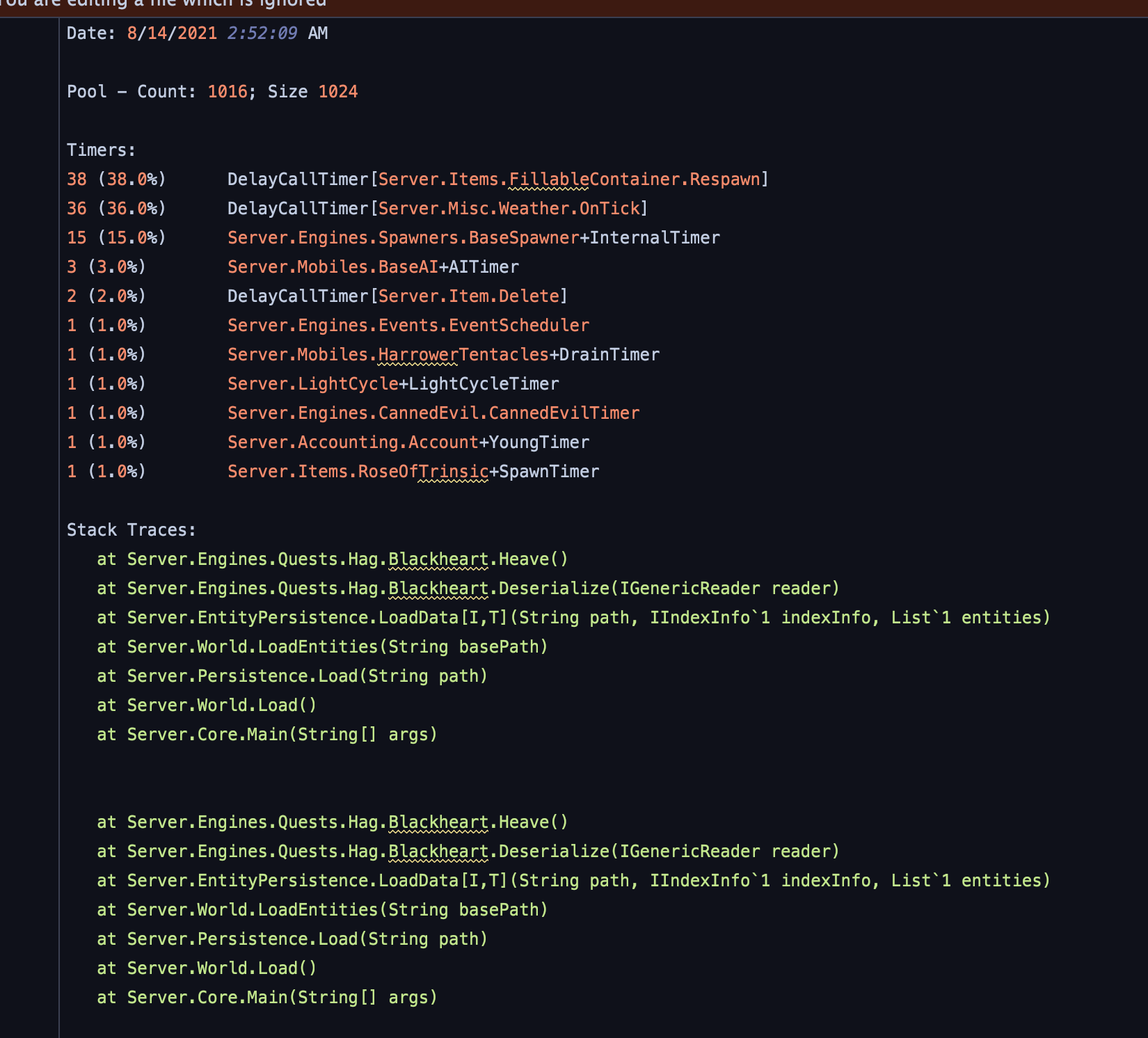
### Updates to [dumptimers
<img width="825" alt="Screen Shot 2021-08-14 at 2 55 10 AM" src="https://user-images.githubusercontent.com/3953314/129442449-ccf7fe14-29d6-4f3f-9366-c8eb7b9828a7.png">
### Changes/Fixes:
* Adds timer pooling.
* Allows pool to be configurable in ModernUO.json
* Pool replenishes itself asynchronously if depleted.
* Fixes an issue with barkeeps and town criers
* Fixes an issue with incognito buff icons not being removed
* Fixes an issue with polymorph name mod not being removed
* Fixes several places where timers go on forever even after an object is deleted, keeping a reference (memory leak)
* Eliminates the timer for MiningCart altogether.
* Deletes `AcidSlime` since it is a duplicate of `PoolOfAcid`
* Fixes HonorableExecution and standardizes the code for other Bushido moves.

## Changes to the Timer API:
```cs
public class Timer
{
  // Creates a timer that will be returned to the pool once execution stops.
  public static void StartTimer(Action callback);
  public static void StartTimer(TimeSpan delay, Action callback);
  public static void StartTimer(TimeSpan delay, TimeSpan interval, Action callback);
  public static void StartTimer(TimeSpan interval, int count, Action callback);
  public static void StartTimer(TimeSpan delay, TimeSpan interval, int count, Action callback);

  // Creates a timer and returns a token for more control. Requires manual cancellation in order for the timer to be returned to the pool.
  // If the token is dereferenced, the timer will be dereferenced too. While not returning a timer to the pool is not considered hazardous, it does defeat the purpose of pooled timers.
  public static void StartTimer(Action callback, out TimerExecutionToken token);
  public static void StartTimer(TimeSpan delay, Action callback, out TimerExecutionToken token);
  public static void StartTimer(TimeSpan delay, TimeSpan interval, Action callback, out TimerExecutionToken token);
  public static void StartTimer(TimeSpan interval, int count, Action callback, out TimerExecutionToken token);
  public static void StartTimer(TimeSpan delay, TimeSpan interval, int count, Action callback, out TimerExecutionToken token);

  // If you aren't sure how to use the API above, or you don't care about performance, then you can use the old RunUO Timer.DelayCall
  public static DelayCallTimer DelayCall(Action callback);
  public static DelayCallTimer DelayCall(TimeSpan delay, Action callback);
  public static DelayCallTimer DelayCall(TimeSpan delay, TimeSpan interval, Action callback);
  public static DelayCallTimer DelayCall(TimeSpan interval, int count, Action callback);
  public static DelayCallTimer DelayCall(TimeSpan delay, TimeSpan interval, int count, Action callback);
}

public struct TimerExecutionToken
{
  public bool Running { get; }
  public int Index { get; }
  public int RemainingCount { get; }
  public DateTime Next { get; }
}
```

## When to use `TimerExecutionToken`?
Use tokens when you want to gain the performance benefit of using a pooled timer, but you need one of the following:
* Access to the next time the timer will tick:`token.Next`
* Access to which interval, how many intervals there are, or how many are remaining: `token.Index`, `token.Count`, and `token.RemainingCount`
* Stop a timer manually.
* Determine if the timer is running: `timer.Running`
* See notes below about requirements for using tokens!

## Notes about using the TimerExecutionToken:
When you opt-in to receive a token, you must call `Cancel()` to return the timer. This can be done inside of the callback, or outside of the callback at any time.
If this is not called and your timer is an infinite interval, then you will create a potential memory leak, or null pointer exception in your callback.
If the timer ends and is stopped, but cancel is not called, then the timer will never return to the pool and stay referenced until the token is deleted or cancel is called. (Memory leak)

## Is this thread safe?
No. The ModernUO timer system is not thread safe at all. If you require a thread safe timer system, contact me and I'll help adapt this system. Keep in mind that there is a massive performance hit to make this thread safe when there are literally no use cases for it.

If you need to synchronize execution, meaning you want to execute code from another thread on the core thread. Let's say you have a discord bot that is pushing commands to the game server. Then use `EventLoopContext.Post(SendOrPostCallback callback, object state);`.
- [X] Fixes bad `ReadEnum` by size
- [X] Fixes array, list, and set not handling null values properly.
  - It will be up to the user (for now) to null out empty lists using `[AfterDeserialization]`. Convenience may be added later.
- [X] Fixes errors with `dotnet clean` and non-empty generation folder
- [X] Fixes bad field indexes on `Account.cs` causing `tags` to not be serialized/deserialized.
  - This was caused by a duplicate entry. Don't have protection against this _yet_.
- [X] Fixes TimeSpan not working with codegen
- [X] Fixes bad check for generic classes with a serialize method and deserialize ctor
- [X] Moves Accounts to codegen so it is versioned
- [X] Fixes deserialization of old Accounts with no version variable.
- [X] Fixes deserialize seek not doing anything. 🙈
- [X] Adds Email to serialization
- Adds `[ManualDirtyChecking]` for anyone that adds it themselves.
- Adds detection of `[Serializable]` and `[ManualDirtyChecking]` at startup to help identify scripts that need migration.
### Additions
- Automatically opts-out `Item/Mobile/Guild/Accounts` from dirty checking with a new property `UseDirtyChecking`
- Codegen now enables `UseDirtyChecking` via getter. This requires that the property is `virtual` for derived types.

### Fixes
- Fixes `EncodedInt` being broken
- Fixes issues with new custom serializable types that are not derived from Item/Mobile/etc.
- Removes double dirty checking.

### Example of a brand new serializable type that isn't an Item/Mobile/etc.
User created code:
```cs
using System;

namespace Server.Items
{
    [Serializable(0)]
    public partial class NewTestEntityObject : ISerializable
    {
        [EncodedInt]
        [SerializableField(0)]
        private int _someProperty;

        public NewTestEntityObject()
        {
            SetTypeRef(GetType());
            // Add to serial tracking like World.Item
            /*
            Serial = World.NewEntity;
            World.AddEntity(this);
            */
        }

        [AfterDeserialization]
        private void AfterDeserialization()
        {
            Console.WriteLine("This ran!");
        }

        public int TypeRef { get; }
        public Serial Serial { get; }
        public void Delete()
        {
        }

        public bool Deleted { get; set; }
        public void SetTypeRef(Type type)
        {
            // Type tracking for persistence goes here
            /*
            TypeRef = World.NewEntityTypes.IndexOf(type);
            if (TypeRef == -1)
            {
                World.NewEntityTypes.Add(type);
                TypeRef = World.NewEntityTypes.Count - 1;
            }
            */
        }
    }
}
```

Generated code:
```cs
namespace Server.Items
{
    public partial class NewTestEntityObject
    {
#pragma warning disable 0414
        private const int _version = 0;
#pragma warning restore 0414

        public int SomeProperty
        {
            get => _someProperty;
            set
            {
                if (value != _someProperty)
                {
                    _someProperty = value;
                    ((ISerializable)this).MarkDirty();
                }
            }
        }

        long ISerializable.SavePosition { get; set; } = -1;
        BufferWriter ISerializable.SaveBuffer { get; set; }
        bool ISerializable.UseDirtyChecking => true;

        public NewTestEntityObject(Serial serial)
        {
            Serial = serial;
            SetTypeRef(typeof(NewTestEntityObject));
        }

        public void Serialize(IGenericWriter writer)
        {

            writer.WriteEncodedInt(_version);

            writer.WriteEncodedInt(SomeProperty);
        }

        public void Deserialize(IGenericReader reader)
        {
            var version = reader.ReadEncodedInt();

            SomeProperty = reader.ReadEncodedInt();

            Timer.DelayCall(AfterDeserialization);
        }
    }
}
```
### Features
* Fully abstracts serialization by using compile-time attributes.
* Supports serializing the following:
  - Primitives (integers, strings, etc)
  - IP Addresses
  - BigDecimal
  - DateTime, Delta DateTimes
  - TimeSpan
  - Server.Race
  - Server.Map
  - Point2D, Point3D, Rect2D, Rect3D
  - Existing/New `ISerializable` references
  - Lists/Sets of serializable types
  - Type with a `Serialize` method and constructor that takes an `IGenericReader`
* Supports forward-only migration
* Supports existing RunUO deserialization for older versions by changing to the following signature:
  - `public void OldDeserialize(IGenericReader reader, int version)`
  - Must remove deserializing the version since this is already done
* Supports serializing from private fields or custom made properties.
* Types do not require inheriting Item/Mobile. Code gen will fully create `ISerializable` information.
  - This is not recommended yet, since it requires wiring to `Persistence` which will cause lots of unresolved symbol errors until code gen is built.

### Example
```cs
using System.Collections.Generic;

namespace Server.Items
{
    [Serializable(1)]
    public partial class TestItem1 : Item
    {
        [SerializableField(1)]
        [SerializableFieldAttr("[CommandProperty(AccessLevel.Administrator)]")]
        private List<Item> _someProperty;

        private void Deserialize(IGenericReader reader, int version)
        {
        }
    }
}
```

Generates this:
```cs
namespace Server.Items
{
    public partial class TestItem1
    {
#pragma warning disable 0414
        private const int _version = 1;
#pragma warning restore 0414

        [CommandProperty(AccessLevel.Administrator)]
        public System.Collections.Generic.List<Server.Item> SomeProperty
        {
            get => _someProperty;
            set
            {
                if (value != _someProperty)
                {
                    ((ISerializable)this).MarkDirty();
                    _someProperty = value;
                }
            }
        }

        public TestItem1(Serial serial) : base(serial)
        {
        }

        public override void Serialize(IGenericWriter writer)
        {
            var savePosition = ((Server.ISerializable)this).SavePosition;
            if (savePosition > -1)
            {
                writer.Seek(savePosition, System.IO.SeekOrigin.Begin);
                return;
            }
            writer.WriteEncodedInt(_version);
            writer.Write(_someProperty);
        }

        public override void Deserialize(IGenericReader reader)
        {
            var version = reader.ReadEncodedInt();
            if (version < 1)
            {
                OldDeserialize(reader, version);
                ((Server.ISerializable)this).MarkDirty();
                return;
            }
            SomeProperty = reader.ReadEntityList<Server.Item>();
        }
    }
}
```

And this:
```json
{
  "version": 1,
  "type": "TestItem1",
  "properties": [
    {
      "name": "SomeProperty",
      "type": "System.Collections.Generic.List\u003CServer.Item\u003E",
      "rule": "ListMigrationRule",
      "ruleArguments": [
        "Server.Item",
        "SerializableInterfaceMigrationRule"
      ]
    }
  ]
}
```
- [X] Caches DateTime.NowUtc on the game loop (not other threads)
- [X] Replaces all locations where it makes sense
- [X] Adds Min/Max for `IComparable` (TimeSpan, DateTimes, etc)
Closes#261
- [X] Removes some string allocations (e.g. split)
- [X] Optimizes some collections
- [X] Converts insensitive to extension methods of built-ins.
- [X] Adds ordinal (case sensitive) string helpers
- [X] Fixes conditionals for in-game commands so they use Ordinal comparisons.
- [X] Replaces ToLower.Contains with InsensitiveContains
- [X] Adds ValueStringBuilder
- [X] Implements ValueStringBuilder in a few places where it makes sense
- [X] Removes the redundant Wrap function and replaces it with an optimized version
- [X] Fixes list conversions in Utility
Closes#351
Bumps release version
## Breaking Change
* IP Matching no longer supports `?` (e.g. you cannot do: "192.16?.0.1")
* IP Matching no longer supports `*` and other values in the same section (e.g. you cannot do "192.1\*.0.1")
  * To do "192.1\*.0.1", you should use the range option with three separate entries: "192.100-199.0.1", "192.1.0.1", "192.10-19.0.1"

## Non-Breaking Changes
- [X] Adds IPv6 support (not for servers though, just clients)
- [X] Adds interning support for IPv4 mapped to IPv6
- [X] Updates IPv4ToAddress (don't use this unless you know it is IPv4 or IPv4 mapped to IPv6)

## Note:
UO Does not support IPv6 for the server. To support an IPv6 server IP you will need to use CUO or some kind of custom client and probably modify it accordingly.

Bumps release version
- [X] Fixes several bugs
- [X] Updates more ordinal issues
- [X] Cleans up the code a bit
- [X] Turns classes static that should have been
- [X] Changes TcpServer.Instances to a HashSet

Bumps release version