## Summary

Stacked on #2676. Review that first; this PR's diff is against it.

Items players sell to NPC vendors go into the vendor's buyback (`ShopBuy`) pack. That pack was purged only when someone opened the buy menu, so a vendor that players sold to but never bought from grew without limit.
- A server operator reported 250k+ items piling up from players crafting and selling on a macro.
- Every one of those items was saved.
- Purging or deleting that vendor then sent one remove packet per item to every nearby client and disconnected them.

The behavior is inherited from RunUO.

- **`VendorBuybackPack`** replaces the plain backpack on `Layer.ShopBuy`.
  - It opts in to `SkipsChildSerialization`, so buyback items are never saved.
  - Its contents are private like any container's, so removing them reaches only the vendor (no client) and openers. Purges and deletes send nothing to bystanders.
- **Capacity.** The buyback holds at most `250 − buy-list entries` items, which is what the buy gump can show. The oldest items are evicted first. At capacity 0 the sold item is consumed and the seller is still paid.
- **Purge on the restock grid.**
  - `Restock()` empties the buyback.
  - A purge-only timer, armed on the first sale, covers vendors nobody buys from. It is due at the next restock boundary after now, so a vendor whose restock hasn't run for hours doesn't purge an item the moment it's sold.
  - The timer never restocks, so stock doubling and halving is unchanged.
  - The old per-item one-hour `LastMoved` check is gone.
- **Existing saves.** A legacy `ShopBuy` pack is replaced on the first tick after load. Thanks to #2676, deleting a pack of 250k+ items takes well under a second.

**Behavior changes for shard operators:**
- A buyback item lasts until the next restock boundary (at most `RestockDelay`), not one hour after its sale.
- A vendor that changes maps drops its buyback.
- A buy window that is open during a purge can show a row whose item is gone. Buying that row does nothing, and reopening shows the current list.

## Test plan

- [x] `VendorBuybackPackTests`: evicts oldest first; capacity 0 consumes the item; purge; a stale front entry can't spin eviction
- [x] `VendorBuybackTests`:
  - purge due time stays on the restock grid, including a stale restock and a restock time in the future;
  - partial stack sale: the split goes to buyback and the seller keeps the remainder;
  - zero capacity consumes the item and still pays;
  - restock purges and clears the timer, and the next sale re-arms it;
  - deleting the vendor cancels the timer;
  - a legacy 20k-item pack is replaced.
- [x] UOContent.Tests and Server.Tests green; schema generator clean
- [x] Manual in-game pass:
  - sell and buy back, including a partial stack;
  - over-capacity sale;
  - purge with no buyer;
  - `[restock`;
  - vendor facet change;
  - restart;
  - legacy save with a large `ShopBuy` pack;
  - mass selling with bystanders present;
  - deleting a vendor with a full buyback.
Tokuno scribes currently load only `SBScribe`, so the existing Zento scribe does not offer the Book of Bushido or Book of Ninjitsu. Add the existing `SBSamurai` and `SBNinja` inventories when `Core.SE && IsTokunoVendor`.

This reuses the existing book prices and default stock quantities. It does not change NPC placement, trainer behavior, or inventories outside Tokuno.

### Sources and reasoning

- The [official UO Ninjitsu guide](https://uo.com/wiki/ultima-online-wiki/skills/ninjitsu/) identifies the scribe at Rokuon Cultural Center in Zento as a seller of the Book of Ninjitsu.
- [UOGuide: Bushido](https://www.uoguide.com/Bushido), documenting standard UO, explicitly lists Tokuno Islands scribe NPCs as a source for the Book of Bushido. This supports adding both book inventories to Tokuno scribes.
- Documentation distinction: the [official UO Bushido guide](https://uo.com/wiki/ultima-online-wiki/skills/bushido/) describes the Zento seller as a samurai trainer, rather than a scribe. The Bushido scribe change follows the explicit UOGuide description. These references do not independently establish the exact historical introduction date or original prices.

### Validation

- Built the change in a customized ModernUO 0.15.6.145 deployment: Release, linux-x64, zero warnings or errors.
- In-game with Mondain's Legacy enabled: both books appeared on the existing Zento scribe, and a player successfully purchased both.
- Reviewed the expansion/location guard for pre-SE and non-Tokuno behavior; those cases were not gameplay-tested. This exact patch has not been built against current upstream main.
When a player selects Bulk Order Info while a cooldown is active on a pre-SE server, the vendor sends localized message 1049039 to itself instead of the requesting player. The player therefore receives no cooldown response.

Change the recipient from `vendor` to `from`, matching the SE branch. Cooldown durations and bulk-order eligibility remain unchanged.

Validation: This one-line fix compiled successfully in our customized 0.15.6.145 server build with zero warnings or errors. The current upstream main branch was not built locally.
## Why

Delta world saves re-serialize an entity only when it has been marked dirty. An audit of the generated classes found three ways serialized state changes without a mark; this PR closes the ones that do not need a new generator package.

## What

- **Custom `[SerializableProperty]` setters mark dirty.** Twelve hand-written setters assigned their backing field without `this.MarkDirty()`. `PlagueBeastLord.OpenedBy` was an auto-property carrying the attribute with no backing field at all; it is now a generated field with the same name, order and command-property exposure.
- **Generated sub-objects are linked to their owner.** Without a `[DirtyTrackingEntity]` member the generator emits setters that mark nothing. Eight entity-owned sub-objects now carry the link and receive the owner through the constructor the generator calls: `BOBFilter` (owner is `IEntity`: a `PlayerMobile` or a `BulkOrderBook`), `BOBLargeSubEntry`, `PuzzleChestSolution` and `PuzzleChestSolutionAndTime`, `TalismanAttribute` (the random factories now take the talisman), `VendorItem`, `PlayerBBMessage`, `RaffleEntry`, `ShardPollOption`. Migration schemas were regenerated with the pinned tool; the only change is the value rule argument becoming `DeserializationRequiresParent`.
- **BaseVendor uses the generator; restock amounts are no longer persisted.** The only state it wrote was which buy entries had grown restock amounts, packed by index into the live `SBInfos` tables. Restock is transient now and rebuilds on load; version 1 records are read and discarded through the legacy path. Every vendor subclass now serializes through a generated chain.

## Generator 4.1.0

This PR adopts SerializationGenerator 4.1.0 (modernuo/SerializationGenerator#55): SG3019/SG3020 diagnostics, `[VolatileSerializedState]`, `StopXxx()` timer helpers, and owner-constructor preference for sub-objects (so dictionary values are constructed with their owner; the 4.0.0 relink fallback is gone). `PlayerVendor.v3.json` gains `DeserializationRequiresParent` for its `VendorItem` values so the migration content struct constructs them with their vendor.

SG3019 is an error under `TreatWarningsAsErrors` and generator diagnostics ignore pragmas, so the five contexts that live in whole-file player-keyed persistences (`ChampionTitle`, `ChampionTitleContext`, `MurderContext`, `VirtueContext`, `JailRecord`) now carry a `[DirtyTrackingEntity]` link to their `PlayerMobile`, which is where they will live once those blobs move onto the player record. `JailSystem.EmptyRecord` keeps a null player (`[CanBeNull]`). `ChampionTitle` needs both a context and a player constructor because the generator resolves the rule against the containing type but emits the call with the parent field; a comment in the file records this.

## Wire format

Unchanged. No version bumps except `BaseVendor` 1 to 2 (which now writes nothing of its own). Schema diffs are rule-argument only (`DeserializationRequiresParent`).

## Testing

Server.Tests 848 passed, UOContent.Tests 759 passed.
> [!Important]
> **Developer Note**
> This code change will **completely move gumps out of the core**


### Summary

- Adds `GetGumps()` convenience which exposes methods to Find/Close/Send multiple gumps. This helper is a performance improvement by eliminating the Dictionary<Player, List> lookup for gumps.
## Summary
- Removes allocation of a `List<ContextMenuEntry>` every time a context menu is created.
- Moves packet/context menu creation logic out of the core
- Fixes tame entry

## BREAKING CHANGE
> [!Important]
> **Developer Note**
> ```cs
> public virtual void GetContextMenuEntries(Mobile from, List<ContextMenuEntry> list)
> ```
> and similar functions changed to
> ```cs
> public virtual void GetContextMenuEntries(Mobile from, ref PooledRefList<ContextMenuEntry> list)
> ```
### Summary
TLDR - .NET Framework rounded TimeSpan (and some DateTime) methods to the nearest millisecond. This was actually _expected_ accidentally for parts of RunUO.
We are aiming to fix this and clean up some other bad assumptions.
Closes#1604
## Breaking Changes (New API)
ObjectPropertyList supports the following API:
```cs
list.Add(500000);
list.Add(500001, stringArgument);
list.Add("Some text");
list.Add($"Some text with {argument}");
list.Add(500002, $"{arg1}\t{arg2}");
```

## Notes
1. All API uses that require a formatter like this:
    ```cs
    list.Add(500002, "{0}\t{1}", arg1, arg2);
    ```
    Should be changed to use string interpolation, for example:
    ```cs
    list.Add(500002, $"{arg1}\t{arg2}");
    ```
2. The following paradigm should no longer be used:
    ```cs
    list.Add(1061170, prop.ToString()); // strength requirement ~1_val~
    ```
    The new string interpolation API will avoid having to convert the argument to a string before writing it to the packet. Instead use the following:
    ```cs
    list.Add(1061170, $"{prop}"); // strength requirement ~1_val~
    ```

### Benchmarks
```cs
|                         Method |     Mean |   Error |  StdDev |  Gen 0 | Allocated |
|------------------------------- |---------:|--------:|--------:|-------:|----------:|
|                BenchmarkOldOPL | 241.0 ns | 0.56 ns | 0.47 ns | 0.0105 |      88 B |
| BenchmarkStringInterpolatedOPL | 199.9 ns | 2.44 ns | 2.39 ns |      - |         - |
```

### Changes
- [X] Removes crash in STArray.Return when array is null.
- [X] Fixes NPE in OPL when entity is null. Serial in packet will be 0 when entity is null.
- [X] Fixes NPE in AosAttributes when Parent is null.
- [X] Changes OPL to use string interpolation.
- [X] Introduces `IPropertyList` to allow extending PropertyList for other uses.
* Removes scaled speed by dex for monsters
* Changes scaled speed by dex for pets (HS+ expansion) to be 400ms -> 100ms between 50 -> 200 dex
* Removes speed changes that were broken for various mobs
* Combines "Legacy" speed and renames the class to `NPCSpeeds`
* Creates speed "classes" (slow, medium, fast, very fast)
* Introduces a new overridable property `SpeedClass`. Register a new speed class using `NPCSpeeds.Register()` and then set the speed class to bulk/mass apply speeds.

Order of speed determination:
1. SpeedMod
2. SpeedClass property (not null)
3. SpeedClass entry in Data\npc-speeds.json for that type
4. "Fast" (200ms Active, 400ms Passive)
* Fixes pooled timer leaking
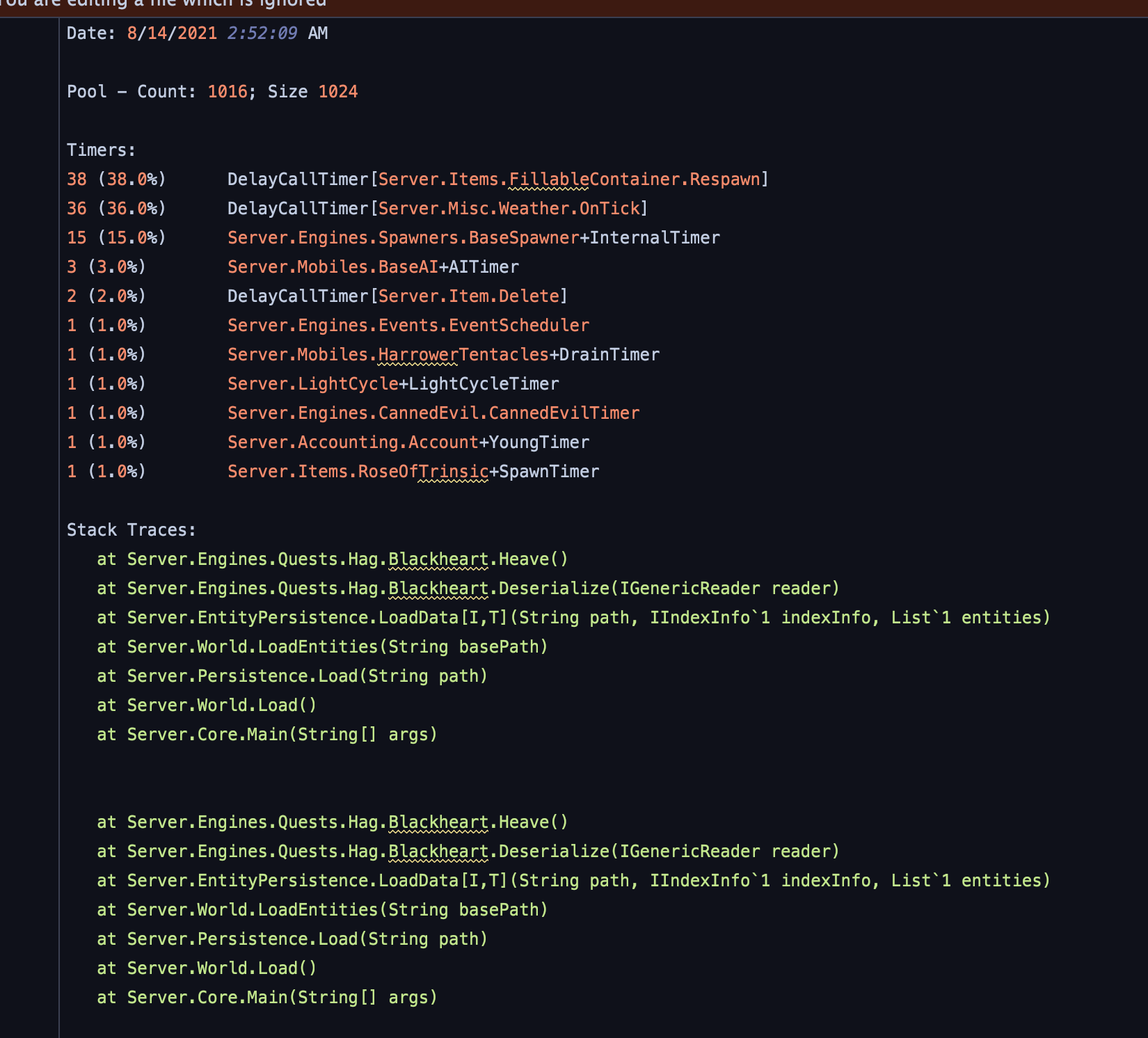
* Fixes `[dumptimers` command so it outputs properly, adds spacing, and stacktraces
* Adds `[Tidy]` for serializing Lists. This will remove deleted entities during world save before serializing the list.
* Adds helpers for managing Lists/Sets/Dictionaries


### New API

```cs
// Creates the list if it is null, then adds
Utility.Add(ref list, value);
Utility.Add(ref set, value);
Utility.Add(ref dict, key, value);

// Nulls the variable if the count is zero
Utility.Remove(ref list, value);
Utility.Remove(ref set, value);
Utility.Remove(ref dict, key);

// Marks entity as dirty in addition to doing the action
entity.Add(list, value);
// Marks entity as dirty, and will create list if it doesn't exist
entity.Add(ref list, value);

// Marks entity as dirty in addition to doing the action
entity.Remove(list, value);
// Marks entity as dirty, and will null the list count is zero
entity.Remove(ref list, value);
```


### Updates to [dumptimers
<img width="825" alt="Screen Shot 2021-08-14 at 2 55 10 AM" src="https://user-images.githubusercontent.com/3953314/129442449-ccf7fe14-29d6-4f3f-9366-c8eb7b9828a7.png">
### Changes/Fixes:
* Adds timer pooling.
* Allows pool to be configurable in ModernUO.json
* Pool replenishes itself asynchronously if depleted.
* Fixes an issue with barkeeps and town criers
* Fixes an issue with incognito buff icons not being removed
* Fixes an issue with polymorph name mod not being removed
* Fixes several places where timers go on forever even after an object is deleted, keeping a reference (memory leak)
* Eliminates the timer for MiningCart altogether.
* Deletes `AcidSlime` since it is a duplicate of `PoolOfAcid`
* Fixes HonorableExecution and standardizes the code for other Bushido moves.

## Changes to the Timer API:
```cs
public class Timer
{
  // Creates a timer that will be returned to the pool once execution stops.
  public static void StartTimer(Action callback);
  public static void StartTimer(TimeSpan delay, Action callback);
  public static void StartTimer(TimeSpan delay, TimeSpan interval, Action callback);
  public static void StartTimer(TimeSpan interval, int count, Action callback);
  public static void StartTimer(TimeSpan delay, TimeSpan interval, int count, Action callback);

  // Creates a timer and returns a token for more control. Requires manual cancellation in order for the timer to be returned to the pool.
  // If the token is dereferenced, the timer will be dereferenced too. While not returning a timer to the pool is not considered hazardous, it does defeat the purpose of pooled timers.
  public static void StartTimer(Action callback, out TimerExecutionToken token);
  public static void StartTimer(TimeSpan delay, Action callback, out TimerExecutionToken token);
  public static void StartTimer(TimeSpan delay, TimeSpan interval, Action callback, out TimerExecutionToken token);
  public static void StartTimer(TimeSpan interval, int count, Action callback, out TimerExecutionToken token);
  public static void StartTimer(TimeSpan delay, TimeSpan interval, int count, Action callback, out TimerExecutionToken token);

  // If you aren't sure how to use the API above, or you don't care about performance, then you can use the old RunUO Timer.DelayCall
  public static DelayCallTimer DelayCall(Action callback);
  public static DelayCallTimer DelayCall(TimeSpan delay, Action callback);
  public static DelayCallTimer DelayCall(TimeSpan delay, TimeSpan interval, Action callback);
  public static DelayCallTimer DelayCall(TimeSpan interval, int count, Action callback);
  public static DelayCallTimer DelayCall(TimeSpan delay, TimeSpan interval, int count, Action callback);
}

public struct TimerExecutionToken
{
  public bool Running { get; }
  public int Index { get; }
  public int RemainingCount { get; }
  public DateTime Next { get; }
}
```

## When to use `TimerExecutionToken`?
Use tokens when you want to gain the performance benefit of using a pooled timer, but you need one of the following:
* Access to the next time the timer will tick:`token.Next`
* Access to which interval, how many intervals there are, or how many are remaining: `token.Index`, `token.Count`, and `token.RemainingCount`
* Stop a timer manually.
* Determine if the timer is running: `timer.Running`
* See notes below about requirements for using tokens!

## Notes about using the TimerExecutionToken:
When you opt-in to receive a token, you must call `Cancel()` to return the timer. This can be done inside of the callback, or outside of the callback at any time.
If this is not called and your timer is an infinite interval, then you will create a potential memory leak, or null pointer exception in your callback.
If the timer ends and is stopped, but cancel is not called, then the timer will never return to the pool and stay referenced until the token is deleted or cancel is called. (Memory leak)

## Is this thread safe?
No. The ModernUO timer system is not thread safe at all. If you require a thread safe timer system, contact me and I'll help adapt this system. Keep in mind that there is a massive performance hit to make this thread safe when there are literally no use cases for it.

If you need to synchronize execution, meaning you want to execute code from another thread on the core thread. Let's say you have a discord bot that is pushing commands to the game server. Then use `EventLoopContext.Post(SendOrPostCallback callback, object state);`.
- [X] Caches DateTime.NowUtc on the game loop (not other threads)
- [X] Replaces all locations where it makes sense
- [X] Adds Min/Max for `IComparable` (TimeSpan, DateTimes, etc)
Closes#261
- [X] Removes some string allocations (e.g. split)
- [X] Optimizes some collections
- [X] Converts insensitive to extension methods of built-ins.
- [X] Adds ordinal (case sensitive) string helpers
- [X] Fixes conditionals for in-game commands so they use Ordinal comparisons.
- [X] Replaces ToLower.Contains with InsensitiveContains
- [X] Adds ValueStringBuilder
- [X] Implements ValueStringBuilder in a few places where it makes sense
- [X] Removes the redundant Wrap function and replaces it with an optimized version
- [X] Fixes list conversions in Utility
Closes#351
Bumps release version
- [X] Fixes an edge case where the cycle index goes negative and crashes
- [X] Fixes average CPS calculation
- [X] Fixes issue with logout delay
- [X] Bumps release version
### API Breaking Change
Combined `AsciiMessage` and `UnicodeMessage` into a single function that takes two arguments, `bool ascii` and `string lang`. Lang can be null (or anything) if ascii is true.

- [X] Changes message packets
- [X] Cleans up some code
- [X] Uses benchmarks to determine if the spanwriter + copyfrom
### Change to how DisplayEquipInfo works
* Fixes a bug where raw name wasn't used
* Fixes another bug where an empty, blank, or null string was still sending an empty crafted by property.

Bumps release version